7 Best AutoDS Alternatives for Shopify Dropshipping in 2026

If you are searching for AutoDS alternatives, it usually means your store has reached a stage where basic product importing and order automation are no longer enough.
Many dropshippers start with automation tools to import products, monitor prices and stock, manage orders, and simplify daily operations. Those functions solve real problems. But as a store grows, the questions become less about moving data and more about controlling the supply chain:
· Where can you find reliable suppliers?
· How do you check product quality before an order ships?
· Can you create a branded customer experience?
· How do you connect sourcing, purchasing, fulfillment, and international shipping in one workflow?
· Will the process remain manageable when order volume increases?
The right AutoDS alternative depends on what your store needs most. One seller may want a broad supplier marketplace. Another may need AliExpress order management. A brand sourcing from China may need purchasing support, warehouse processing, quality checks, packaging, and global delivery. The goal is not to choose the platform with the longest feature list. It is to choose the operating model that fits your store.
Need more than product importing? Create a BuckyDrop account and test how sourcing, purchasing, quality checks, packaging, and fulfillment can work together for one product.
Why Are Dropshippers Looking for AutoDS Alternatives?

AutoDS currently presents itself as an all-in-one dropshipping automation platform. Its public feature set includes product discovery and importing, inventory and price monitoring, automatic order fulfillment, tracking updates, and integrations with ecommerce channels such as Shopify and WooCommerce. For sellers focused on listing products and automating repetitive store tasks, that combination can be useful.
The search for an alternative often starts when the bottleneck changes. Automation may move orders faster, but it does not automatically answer every supply-chain question. Growing sellers may need more visibility into who supplies a product, what happens when it reaches a warehouse, how variations are checked, whether packages can be customized, or which shipping route fits the destination and margin.
Common reasons to compare alternatives include:
· You want access to a different supplier ecosystem, such as Taobao, 1688, AliExpress, or local US and EU suppliers.
· You need a fulfillment partner to receive, process, consolidate, or inspect products before international shipping.
· You want packaging, labels, inserts, or other brand-building options.
· You need more control over shipping routes, tracking, and landed cost.
· You want a workflow that supports Shopify, WooCommerce, or a custom store through plugins or an API.
· Your order volume has made manual supplier communication and exception handling difficult.
In short, dropshipping automation and supply-chain execution are related, but they are not identical. Some AutoDS alternatives are primarily software. Others combine software with sourcing and fulfillment services. Knowing which problem you are solving is the first comparison filter.
What Should You Compare When Choosing an AutoDS Alternative?
Before opening pricing pages, map the tasks that currently take the most time or create the most risk. Then compare each platform against the same criteria.
Area | Questions to ask |
Product sourcing | Which marketplaces or supplier regions can you access? Can you request sourcing for a product that is not in the catalog? |
Automation | Can the platform import products, sync orders, update inventory, and send tracking information back to your store? |
Fulfillment | Who purchases the item, receives it, processes it, and handles exceptions before shipment? |
Quality control | Can you request product or package checks before the parcel leaves the warehouse? What does the check include? |
Branding | Are custom packaging, labels, inserts, or private-label services available? Do they require volume commitments? |
Shipping | Which origins, destinations, carriers, and delivery options are supported? Can you estimate total landed cost before listing? |
Integration | Does it support Shopify, WooCommerce, other channels, or an API that matches your store setup? |
Scalability | How are bulk orders, inventory, returns, supplier changes, and support handled as volume grows? |
Do not treat a free plan as the total cost. Product cost, domestic freight, fulfillment fees, packaging, international shipping, payment costs, returns, and subscription charges all affect the final margin. Test the complete cost of one realistic order before migrating your catalog.
AutoDS Alternatives Comparison
The table below is a starting point, not a universal ranking. Each option fits a different sourcing and operating model.
Platform | Best for | Sourcing model | Main point to verify |
BuckyDrop | China sourcing plus fulfillment | Taobao, 1688, and other Chinese marketplaces supported through a service workflow | Service scope, shipping route, and total landed cost for your products |
Zendrop | Managed catalog, fulfillment, and brand-building options | Platform catalog plus sourcing and fulfillment services | Which branding and fulfillment features apply to your plan and order volume |
CJdropshipping | Broad China-linked catalog and multi-channel fulfillment | Catalog products, sourcing requests, and warehouse fulfillment | Product-level availability, shipping method, and warehouse location |
DSers | AliExpress product and order management | AliExpress-connected ordering workflow | Supplier reliability and the limits of marketplace-based fulfillment |
Spocket | Access to US, EU, and global suppliers | Curated supplier marketplace | Supplier location, delivery region, product cost, and return terms |
Syncee | Global supplier discovery and catalog synchronization | Dropshipping and wholesale marketplace with supplier-managed shipping | Supplier-specific shipping, approval, and order terms |
Dropified | Software-led product, store, and order automation | Automation platform connected to multiple product sources | Whether its supplier and fulfillment model matches the operational control you need |
1. BuckyDrop: A China Sourcing and Fulfillment Alternative for Shopify Sellers
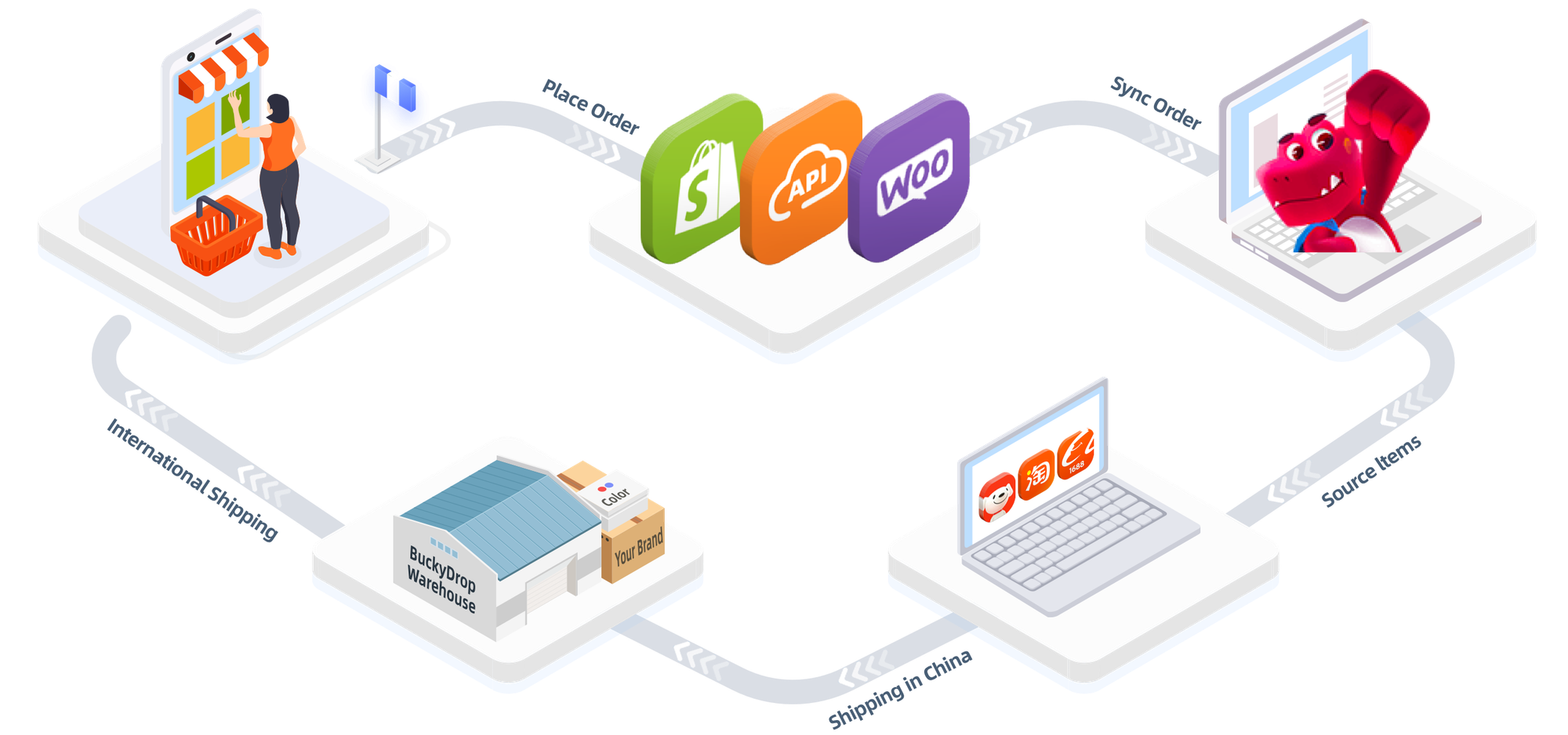
Best for: sellers who want to connect Chinese marketplace sourcing with purchasing, warehouse processing, and international fulfillment
If your store depends on products from China, the main challenge is usually not automation alone. You also need supplier communication, product purchasing, quality checks, warehouse processing, packaging options, and international shipping. BuckyDrop is designed to help sellers connect these steps into one workflow.
BuckyDrop is suitable for sellers sellers who want to source products from Taobao, 1688, Tmall, Xianyu, JD, Weidian, and other Chinese platforms. We help you manage product sourcing, purchasing, warehousing, processing, order fulfillment, international shipping, and tracking updates in one workflow. You can connect your Shopify or WooCommerce store through our plugins, or explore the BuckyDrop API if your business requires a customized integration.
If you are considering 1688 dropshipping or Taobao sourcing but do not want to manage every domestic purchase, warehouse receipt, package check, and cross-border shipment manually, BuckyDrop can help. We connect your store with Chinese marketplace suppliers, warehouse processing, and international delivery, giving you a more coordinated workflow than a basic China dropshipping website or product catalog.
· Source products from Taobao, 1688, and other Chinese marketplaces.
· Coordinate purchasing and supplier communication.
· Receive products at a warehouse for processing or requested checks.
· Prepare packages and evaluate branding or value-added service options.
· Fulfill international orders and update logistics tracking.
· Connect Shopify, WooCommerce, or eligible custom workflows.
What to check before choosing it: Confirm the current fee structure, service eligibility, inspection scope, packaging requirements, route availability, and estimated landed cost for each destination. Services and costs can vary by product and request.
Looking for a sourcing and fulfillment workflow beyond product automation? Create a BuckyDrop account and test one product from sourcing to delivery.
2. Zendrop: A Managed Workflow for Catalog Sourcing and Fulfillment
Best for: sellers who prefer a managed product catalog, automated fulfillment, and optional brand-building services
Zendrop combines product sourcing, store connection, automated fulfillment, shipping, print-on-demand, and selected branding options. Its public materials describe US- and China-based fulfillment resources, while advanced private-label and custom-packaging services may depend on program eligibility, order volume, or upfront commitments.
For a Shopify seller who wants to stay inside a managed platform rather than communicate with many suppliers directly, that structure can reduce operational fragmentation. It can also be useful for sellers who want to start with catalog products and later explore more customized fulfillment.
· One-click product importing and automated fulfillment workflows.
· Product sourcing and catalog discovery.
· US and China fulfillment options for eligible products.
· Branding and private-agent options for qualifying sellers.
What to check before choosing it: Check the exact fulfillment origin, destination coverage, delivery estimate, product eligibility, subscription requirements, and branding conditions. Not every feature applies to every supplier or product.
3. CJdropshipping: Broad Catalog Access and Multi-Channel Fulfillment
Best for: sellers who want a large catalog, sourcing requests, multiple store integrations, and warehouse-based fulfillment options
CJdropshipping connects product sourcing with listing, store authorization, order synchronization, warehousing, packing, shipping, and tracking. Its official site supports sourcing requests when a product is not already in the catalog and lists integrations with Shopify, WooCommerce, and several other ecommerce channels.
This can suit sellers who want to browse a ready catalog while keeping the option to request sourcing or use different warehouses. It also gives multi-channel sellers a single place to connect products and orders across supported stores.
· Catalog browsing and product sourcing requests.
· Shopify, WooCommerce, and other channel integrations.
· Automatic order import and tracking updates.
· Warehouse, packaging, print-on-demand, and shipping services for eligible products.
What to check before choosing it: Verify the actual stock location, processing time, shipping method, quality expectations, and product-specific fees. Catalog availability does not mean every item has the same fulfillment speed or service options.
4. DSers: An AliExpress-Focused Ordering Alternative
Best for: sellers whose catalog and supplier relationships remain centered on AliExpress
DSers is closely connected to the AliExpress ordering workflow. Its official materials describe product importing, supplier mapping, bulk order placement, order status synchronization, and tracking updates back to Shopify. That makes it a practical alternative when your priority is handling AliExpress orders more efficiently rather than building a separate warehouse workflow.
The key distinction is that DSers helps manage marketplace ordering. The supplier still plays a major role in product consistency, processing, and shipment. Sellers therefore need a clear supplier-selection and backup-supplier process.
· AliExpress product importing and supplier mapping.
· Bulk order placement and order management.
· Tracking-number synchronization with connected stores.
· A familiar workflow for sellers already using AliExpress.
What to check before choosing it: Review each supplier’s history, processing time, shipping options, return handling, and ability to maintain the same product specification. Software efficiency cannot compensate for an unsuitable supplier.
5. Spocket: A Supplier Marketplace with a US and EU Focus
Best for: sellers who prioritize supplier location and faster regional delivery options in the US or Europe
Spocket positions its marketplace around reviewed suppliers, including a strong concentration in the US and EU, with Shopify and WooCommerce connections. Its supplier profiles can help sellers compare origin and delivery information before adding products to a store.
This approach may appeal to stores whose customers value regional shipping or products that are less dependent on a China-based supply chain. The trade-off is that regional supplier pricing and catalog depth may differ from Chinese marketplace sourcing.
· Supplier discovery with location and shipping information.
· Shopify and WooCommerce product and order workflows.
· Sample ordering for product evaluation where available.
· US, EU, and global supplier options.
What to check before choosing it: Compare product cost, shipping region, delivery estimate, return address, subscription level, and supplier-specific terms. “Local supplier” should always be verified at the product level.
6. Syncee: Global Supplier Discovery and Catalog Synchronization
Best for: sellers who want to compare suppliers from multiple regions or synchronize an existing supplier data feed
Syncee operates as a dropshipping and wholesale marketplace connecting retailers with suppliers in regions including the US, Canada, Europe, the UK, and Australia. Its public platform description includes product importing, inventory updates, order synchronization, tracking, pricing rules, and supplier-managed shipping.
For sellers who already have a supplier outside the marketplace, Syncee also offers a data-feed workflow on supported plans and platforms. This can be useful when the main problem is keeping a large supplier catalog synchronized rather than outsourcing physical warehouse operations.
· Global supplier and product discovery.
· Product upload, inventory updates, and pricing controls.
· Order and tracking synchronization.
· Marketplace and external supplier data-feed workflows.
What to check before choosing it: Check whether a supplier requires approval, where it ships from, which destinations it serves, how returns work, and whether order payment is automated or requires an action in the platform.
7. Dropified: A Software-Led Automation Option
Best for: sellers who want software for product discovery, store building, content, and automated order workflows
Dropified emphasizes automation across product research, Shopify product-page creation, marketing content, orders, tracking, and fulfillment connections. It may be relevant to a seller whose main bottleneck is launching products and automating digital store tasks.
Its value proposition is software-led, so it should be evaluated differently from a service that physically receives, checks, or repackages products. If quality control, consolidation, or custom warehouse processing is essential, confirm who performs those tasks and where responsibility sits.
· Product research and product-page creation tools.
· Store and marketing automation features.
· Order, tracking, and fulfillment automation connections.
· Support for sellers who prefer a software-centered workflow.
What to check before choosing it: Confirm the supported product sources, store integrations, fulfillment responsibility, and total subscription cost for the features you will actually use.
How to Choose the Right AutoDS Alternative for Your Store

A useful decision starts with your operating model, not a generic feature score.
· Choose BuckyDrop to evaluate a China sourcing and fulfillment workflow involving Taobao, 1688, purchasing, warehouse processing, and international shipping.
· Choose Zendrop if you want a managed catalog and fulfillment environment with optional branding paths.
· Choose CJdropshipping if you want a broad catalog, sourcing requests, and several channel or warehouse options.
· Choose DSers if AliExpress remains your main marketplace and bulk ordering is the priority.
· Choose Spocket if supplier location in the US or EU is central to your customer promise.
· Choose Syncee if you need global supplier discovery or catalog synchronization across marketplace and external supplier feeds.
· Choose Dropified if your biggest need is software-led product, store, and order automation.
Many established stores use more than one sourcing route. You may test products through one catalog, source a proven product through a China marketplace, and move higher-volume inventory into a dedicated fulfillment arrangement. The important part is to keep SKU mapping, inventory ownership, cost calculation, tracking, and customer policies consistent across the stack.
A Practical Migration Checklist
1. Export your current product, variant, supplier, order, and tracking data before changing tools.
2. Choose one representative product with real variants, realistic weight, and a typical destination.
3. Calculate landed cost, including product price, domestic freight, handling, inspection, packaging, international shipping, payment costs, and expected returns.
4. Place a sample order and check product accuracy, packaging, processing time, tracking quality, and customer-facing delivery updates.
5. Test order synchronization, address handling, variant mapping, cancellations, refunds, and tracking updates in your Shopify store.
6. Create a backup supplier or fallback fulfillment route for your highest-risk products.
7. Move products in stages and monitor margin, delivery performance, support tickets, and refund reasons before a full migration.
Frequently Asked Questions
What is the best AutoDS alternative for Shopify?
For Shopify sellers who need more than product importing and basic order automation, BuckyDrop is a strong AutoDS alternative to consider. We help connect your Shopify store with product sourcing from Taobao, 1688, and other Chinese marketplaces, while supporting purchasing, warehouse processing, product checks, packaging, international fulfillment, and tracking updates in one workflow.
This makes BuckyDrop particularly suitable if you want greater control over your China supply chain without manually coordinating suppliers, warehouses, and shipping providers. You can connect your Shopify store through the BuckyDrop plugin or explore our API for a more customized integration.
Other platforms may fit narrower requirements. DSers focuses mainly on AliExpress order management, while Spocket and Syncee provide access to regional or global supplier marketplaces. The right choice still depends on your sourcing model, target market, and fulfillment needs, so test the complete workflow with a real product and destination before migrating your full catalog.
Is there a free AutoDS alternative?
Several platforms offer a free plan, free account, trial, or limited browsing access, but “free” rarely covers the entire order journey. Check subscription limits as well as product cost, fulfillment charges, shipping, packaging, and returns. The lowest software price is not always the lowest landed cost.
Is there an AutoDS alternative for Taobao and 1688 sourcing?
Yes. BuckyDrop supports sourcing and purchasing workflows involving Taobao, 1688, and other Chinese marketplaces, together with warehouse processing and international fulfillment. This can be relevant when you need more than a product importer and would otherwise coordinate a China sourcing agent, warehouse, and shipping provider separately.
Can I connect an AutoDS alternative to Shopify?
All seven options in this article offer a Shopify-related workflow, but the scope varies. Some focus on product and order data, while others combine store connection with physical sourcing or fulfillment. Confirm product import, order sync, inventory updates, tracking, billing, and cancellation behavior before connecting a live catalog.
Which alternative is better for branding?
Look beyond a “branding available” label. Ask whether the service supports inserts, labels, custom packaging, private labeling, or product customization; what minimum volume applies; who approves artwork; and how samples are handled. BuckyDrop, Zendrop, and CJdropshipping each publish branding or custom-packaging options, but eligibility and costs can vary by product and program.
Should I switch platforms as soon as orders start growing?
Not necessarily. First identify the actual bottleneck: supplier reliability, manual ordering, quality control, shipping, inventory, branding, or support. Test a new workflow with a limited number of products before moving the full catalog. A staged migration reduces the risk of broken variants, missed orders, or unexpected costs.
Conclusion: Move Beyond Automation When Your Supply Chain Requires It
AutoDS alternatives should not be judged only by how many products they can import or how many tasks they automate. As your store grows, the more important question is whether the workflow gives you the supplier access, fulfillment control, shipping visibility, and brand experience your customers expect.
If your business is still centered on straightforward marketplace ordering, a software-led tool may be enough. If you are moving toward Taobao or 1688 sourcing, product checks, warehouse processing, packaging, and global fulfillment, you need to evaluate the full supply chain, not only the app interface.
Start with one product, one target market, and one complete cost calculation. The best AutoDS alternative is the one that makes that real order easier to source, fulfill, track, and support without weakening your margin or customer experience.
Ready to evaluate a China sourcing and fulfillment workflow? Create a BuckyDrop account, connect your store, and test one product from sourcing to delivery.