How Much Does Dropshipping Fulfillment Cost in the US? A Guide to China Sourcing, Shipping and Shopify Automation

Quick answer
There is no reliable flat cost for a US dropshipping order. The real figure is the sum of product cost, China domestic shipping, purchasing and warehouse handling, inspection or value-added services, packaging, international transportation, import charges where applicable, payment costs, and an allowance for returns or delivery exceptions. Calculate this total for one real SKU and one real US ZIP code before setting the retail price.
A supplier listing can make a product look profitable. A US customer sees a $34.99 offer, while the product appears to cost only $8.50 in China. The gap looks generous—until China domestic freight, warehouse processing, quality checks, packaging, dimensional weight, international shipping, duties, payment fees, refunds and advertising are added.
That is why the first question is not simply, “Which platform is cheapest?” It is: What will one successfully delivered US order actually cost?
At BuckyDrop, we connect China sourcing, purchasing, warehouse receiving, quality checks, packaging, shipping and tracking with Shopify, WooCommerce and independent-store workflows. This guide shows US-focused sellers how to calculate the full order cost, compare fulfillment models and test the workflow before scaling.
Calculate the US fulfillment cost of one real product. Use the BuckyDrop Shipping Calculator with the product category, parcel weight, dimensions, destination state and ZIP code; then create a BuckyDrop account to validate the complete workflow.
1. What Is Included in a US Dropshipping Fulfillment Cost?
A useful dropshipping fulfillment cost model separates controllable operating costs from taxes and variable risks. Use this formula:
True order cost = Product + China domestic shipping + purchasing/warehouse processing + inspection/value-added services + packaging + international shipping + applicable import charges + payment/platform fees + expected exception allowance |
Cost layer | What it covers | What US sellers should verify |
Product cost | Supplier price for the exact variant | A low listing price may apply only to one size, color or minimum quantity. |
China domestic shipping | Supplier-to-warehouse delivery | Orders from multiple suppliers may create multiple domestic shipments. |
Purchasing and warehouse processing | Procurement, receiving and order handling | Confirm which actions are included and which are charged separately. |
Inspection and services | Quality-check depth, photos, labels, inserts or consolidation | The cheapest inspection may not cover the defect risks that matter for the product. |
Packaging | Mailer, box, protective material and custom packaging | A larger parcel can increase billable dimensional weight. |
International shipping | China-to-US transportation and handoff to the last-mile network | Quote by actual product, parcel data and destination ZIP code. |
Import charges | Duties, taxes, fees or customs-related costs where applicable | Do not assume a low-value shipment is automatically duty-free. |
Exception allowance | Refunds, reshipments, address issues, loss or damage | Use actual store data as soon as it becomes available. |
A China sourcing agent should make the supplier-side workflow visible enough for a seller to understand where money and time are being added. The goal is not merely to find a lower product price; it is to turn the product into a trackable, deliverable US order.
2. A USD Example: Why the Product Price Is Not the Order Cost
Consider a hypothetical Shopify product sold for $34.99. The figures below are illustrative only; they are not BuckyDrop quotes or promised rates.
Line | Illustrative USD | Interpretation |
Retail price | $34.99 | Customer payment before tax, discounts and refunds |
Product | $8.50 | Exact SKU from the supplier |
China domestic shipping | $1.20 | Supplier to China warehouse |
Warehouse/QC/services | $1.10 | Illustrative receiving and selected service allowance |
Packaging | $0.60 | Illustrative protective packaging |
International shipping | $7.40 | Illustrative China-to-US shipment |
Payment/platform fees | $1.40 | Illustrative store/payment cost |
Exception allowance | $1.25 | Illustrative return/reshipment allowance |
Total before ads and seller tax obligations | $21.45 | Retail price less this total leaves $13.54 before advertising and other business overhead |
This example explains why “product cost × 3” is not a dependable pricing rule. A small change in parcel dimensions, shipping route or refund rate can materially change contribution margin. Use current inputs instead of copying another store’s estimate.
Practical test: Run three versions for the same SKU: expected parcel data, a heavier parcel, and a remote US ZIP code. If the offer is profitable only in the best-case version, the product is not ready for paid traffic. |
3. What Most Often Destroys Margin on US Orders?
Dimensional weight
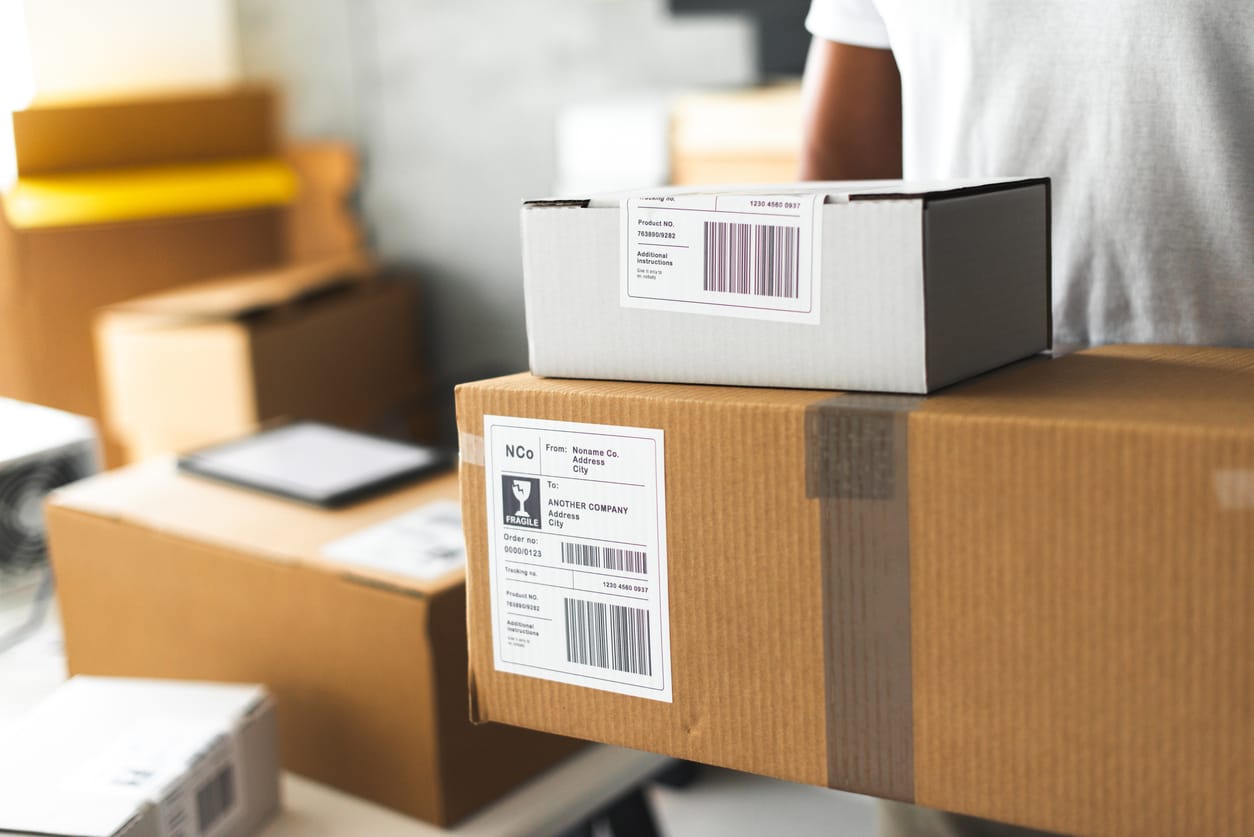
Carriers may charge by billable weight rather than scale weight. Bulky but light products—pillows, large organizers, plush goods or oversized packaging—can therefore cost more to ship than expected. Record the packed dimensions, not only the product dimensions.
Several suppliers for one customer order
If a customer purchases items sourced from different Chinese suppliers, the order may create several domestic shipments before consolidation. Consolidation can simplify the customer parcel, but it adds receiving time and must be compared with split-shipping cost and customer experience.
Variant and inventory errors
A low-cost quote is meaningless if the wrong color, size or variant is purchased. Variant mapping, inventory updates and product-source binding matter because a replacement or refund can erase the margin from several successful orders.
Weak packaging decisions
Overpacking increases dimensional weight; underpacking increases damage risk. The best choice is product-specific. Fragile items, liquids, apparel and products with retail boxes need different handling rules.
Ignoring failed-delivery and return costs
US return expectations can be expensive for cross-border sellers. Before advertising, decide what happens when an address is wrong, a parcel is refused, tracking stops, or the customer requests a return. The policy shown in the store should match the workflow the business can actually support.
4. How Long Does Dropshipping Shipping to the US Take?
Do not confuse carrier transit time with the customer’s total wait. For international shipping from China to USA, the complete timeline is:
Customer delivery time = Supplier processing + China domestic delivery + warehouse receiving/inspection + packing/dispatch + international transit + customs processing + US last-mile delivery |
Route objective | Best fit | Main advantage | Main trade-off |
Economy | Low-margin, non-urgent products | Lower transport cost | Longer or less predictable delivery window |
Balanced | Most validated Shopify products | Cost/time balance | Still requires route-specific testing |
Faster or express | Higher-value, urgent or replacement orders | Shorter transport objective | Higher cost; product restrictions may apply |
USPS, UPS and FedEx are familiar names to US customers, but the final-mile carrier depends on the selected route and current service arrangement. A cross-border line may hand a parcel to a local partner after US entry. Sellers should verify the displayed route, tracking coverage, destination limitations and current estimated time rather than promise a carrier name before confirming availability.
For an honest delivery promise, test the full timeline with a real order. Record the supplier purchase date, warehouse receipt date, inspection completion, parcel dispatch, first US scan and delivery date. This gives the store a defensible estimate instead of a copied “7–10 days” claim.
5. Direct China Fulfillment vs. US Warehouse Fulfillment
Model | Advantages | Limitations | Best for |
Direct from China | Wide sourcing access; low inventory commitment | Longer cross-border journey; import cost and delivery variability | Testing products and long-tail catalogs |
US warehouse inventory | Faster domestic dispatch and easier local returns | Inventory cash, storage fees and demand-forecast risk | Stable winners with predictable US demand |
Hybrid | Test from China, then stock proven SKUs locally | Requires routing and inventory discipline | Sellers moving from validation to scale |
There is no universally best model. Direct China fulfillment often makes sense while demand is uncertain. Local US inventory can make sense after a SKU has stable sales, predictable returns and enough margin to carry stock. A hybrid approach keeps the testing catalog flexible while placing proven items closer to customers through a separately arranged US warehouse.
At BuckyDrop, our strongest value is connecting China-side sourcing and dropshipping fulfillment in one operating workflow. Sellers can use that visibility to test products before making larger inventory commitments.
6. US Import Charges and Sales Tax: Two Different Questions
Important: This section is operational guidance, not legal or tax advice. Rules depend on product, origin, value, importer arrangement, destination, sales activity and current law. Verify with CBP, state authorities and qualified advisors. |
Import duties and customs
Do not build a 2026 US pricing model on the assumption that every shipment under $800 is duty-free. US Customs and Border Protection states that duty-free de minimis treatment was suspended for qualifying low-value imports from all countries effective August 29, 2025. Applicable duties, taxes and fees can therefore affect the delivered cost. Product classification, declared value, country of origin, carrier method and importer arrangement matter.
US sales tax
Sales tax is separate from import duty. Shopify explains that US tax liability can depend on where products ship from and to, where the seller is registered, product taxability, buyer exemptions, and physical or economic nexus. Inventory or fulfillment activity in a state can affect the analysis. Determine where the business is required to register before enabling collection; BuckyDrop does not determine or file a seller’s US tax obligations.
Product and platform requirements
Before listing a product, confirm whether it is restricted for import, needs testing or labeling, contains batteries, liquids, magnets, branded intellectual property or other controlled characteristics, and is permitted by the payment provider and ecommerce platform. Accurate descriptions, values and product data help prevent avoidable customs and customer-service problems.
· Confirm the product category, materials, battery/liquid/magnet status and brand authorization.
· Confirm who is responsible for import declarations, duties and exception handling under the selected route.
· Review sales-tax nexus with state authorities or a qualified professional.
· Set a store policy for delivery estimates, address changes, failed delivery, refunds and returns.
7. Shopify Settings That Affect Fulfillment Cost and Customer Trust
A Shopify dropshipping fulfillment workflow is not complete when a parcel leaves the warehouse. Store settings must reflect the actual shipping operation.
· Product data: Keep SKU and variant mapping accurate; enter realistic weight and package data where the checkout setup uses them.
· Shipping rates: Decide whether to charge a flat rate, calculated rate or free shipping built into the product price. Protect margin for oversized or remote-destination orders.
· Fulfillment location: Understand how Shopify assigns inventory and routes orders when more than one location or service is configured.
· Tracking: Ensure the carrier or tracking URL is returned to the order so customers can use Shopify’s order-status page and shipping notifications.
· Delivery communication: Show a realistic processing window and transit estimate. Do not display a domestic-style promise for a cross-border workflow unless performance supports it.
The same operating questions apply to WooCommerce dropshipping: how orders reach the fulfillment workflow, how variants and sources are mapped, how inventory changes are synchronized and how tracking returns to the store.
8. What Should US Sellers Compare in a Dropshipping Fulfillment Platform?
The best dropshipping fulfillment platform for Shopify is not automatically the one with the lowest visible shipping number. It is the platform that makes the complete workflow testable for the seller’s product, destination and order volume.
Decision area | Question to ask | Why it matters |
True order cost | Can you see product, processing, service, packaging and route inputs separately? | Prevents a cheap quote from hiding an unprofitable order |
China sourcing | Can it source or connect the exact SKU and supplier? | Product selection and supplier access affect margin |
Variant/inventory control | Can store variants and inventory changes be synchronized? | Reduces wrong-item and overselling risk |
Quality and exception workflow | What is inspected, documented and done when an item fails? | Clarifies who owns the resolution before dispatch |
Packaging | Can packaging rules match product fragility and brand needs? | Balances damage prevention, parcel size and customer experience |
US shipping options | Can routes be compared using weight, dimensions, category, state and ZIP code? | Makes the quote relevant to a real destination |
Order and tracking sync | Can orders and tracking move between store and fulfillment workflow? | Reduces manual work and customer-status gaps |
Human support | Is there a clear escalation path for procurement and shipping exceptions? | Automation still needs accountable exception handling |
9. How BuckyDrop Supports a US-Focused Workflow
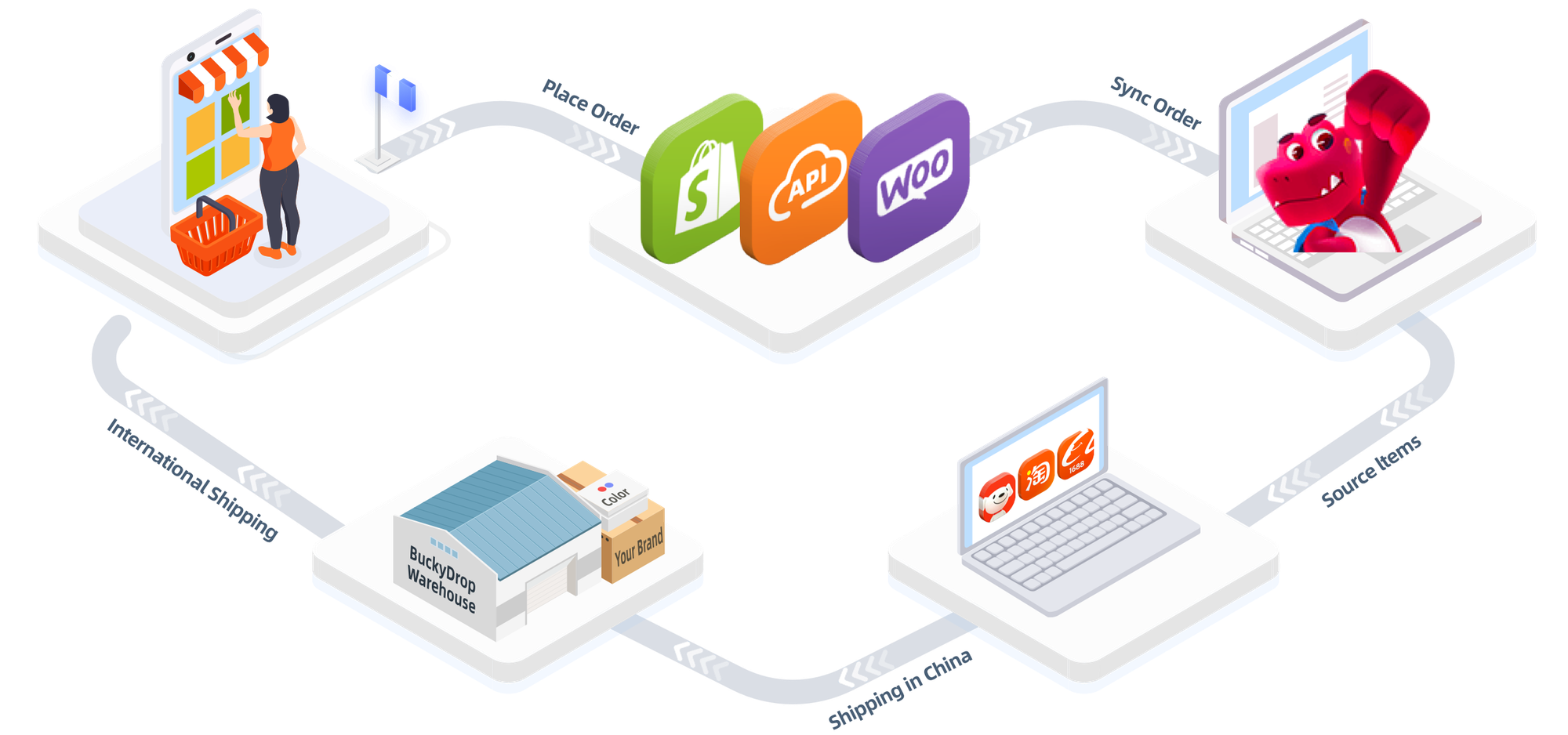
At BuckyDrop, we are designed to connect China sourcing with ecommerce operations—not merely forward a parcel. Our official workflow supports product sourcing across major Chinese marketplaces, purchasing, warehouse receiving, quality checks, value-added services, packaging, international shipping choices and logistics tracking updates.
For Shopify and WooCommerce sellers, our store connection supports product and order workflows, inventory updates and automated order fulfillment. When a store’s needs go beyond a standard plugin connection, our official site also describes a configurable dropshipping API option for personalized platform access.
This helps address the operational gap between finding a product in China and delivering the correct order to a US customer:
· Sourcing gap: We help sellers access Chinese marketplace products and connect product sources instead of relying on a narrow catalog.
· Cost gap: Our shipping calculator accepts destination, state, ZIP code, weight, parcel dimensions, warehouse and item category inputs so sellers can test a relevant route estimate.
· Quality gap: Sellers can include quality checks and selected services before international dispatch, according to the service scope chosen.
· Manual-work gap: Store and order connections support dropshipping order automation, reducing repeated handoffs across purchasing, fulfillment and tracking.
· Brand gap: After a product proves demand, sellers can evaluate private label dropshipping, custom packaging, labels or other product-appropriate services.
What we do not promise: A single fixed US shipping time, guaranteed duty outcome, guaranteed margin or automatic tax compliance. Product category, parcel data, destination, service availability and current rules must be checked for each workflow. |
10. Test BuckyDrop with One US Order Before You Scale
1. Create a BuckyDrop account and connect the relevant Shopify or WooCommerce store.
2. Choose one representative SKU—not the easiest SKU. Include a realistic variant, package type and product category.
3. Connect or request the product source and confirm the exact supplier variant, China domestic delivery and purchasing inputs.
4. Enter the packed weight and dimensions, item category, US destination state and ZIP code in the BuckyDrop Shipping Calculator. Compare available route objectives instead of assuming one carrier or one speed.
5. Select the inspection, packaging and value-added services the product actually needs.
6. Calculate contribution margin in USD, including import-cost assumptions, payment fees, advertising and an exception allowance.
7. Place one controlled order. Record each timestamp, tracking milestone, parcel condition and customer-facing status update.
8. Scale only after the real result supports the store’s price, delivery promise and support policy.
Test the complete route from China sourcing and warehouse processing to US delivery and tracking. Create your BuckyDrop account, connect your store and start with one representative US order.
Frequently Asked Questions
How much does dropshipping fulfillment cost in the US?
There is no universal rate. Calculate product cost, China domestic freight, purchasing and warehouse processing, inspection or services, packaging, international shipping, applicable import charges, payment/platform fees and an allowance for exceptions. Use the exact SKU, packed parcel data and destination ZIP code.
How long does dropshipping from China to the US take?
Total customer wait includes supplier processing, China domestic delivery, warehouse receiving and inspection, packing, international transit, customs and last-mile delivery. Route estimates cover only part of that timeline, so validate the complete process with a test order.
What is the best dropshipping fulfillment platform for Shopify?
The best fit is the platform that supports the seller’s sourcing market, store connection, product/variant control, inspection requirements, packaging, US route comparison, tracking synchronization and exception workflow at an acceptable total cost. Test those steps with one product before scaling.
Can Shopify dropshipping orders be fulfilled automatically?
BuckyDrop supports Shopify store connection and order workflows that can automate steps from order synchronization through purchasing, fulfillment and tracking updates. Sellers should configure rules, maintain account balance where required, and monitor exceptions rather than treating automation as unattended risk transfer.
Can WooCommerce stores use the same workflow?
Yes. BuckyDrop’s official guide supports Shopify and WooCommerce store connections. The seller should verify product mapping, order settings, logistics rules and tracking behavior in a controlled order.
Will USPS, UPS or FedEx deliver the package?
The last-mile carrier depends on the route and current service arrangement. Check the route details and tracking information available for the specific shipment rather than promising a carrier name in advance.
When should a seller move inventory to a US warehouse?
Consider local inventory after a SKU has repeatable US demand, acceptable return behavior, predictable dimensions and enough margin to support inventory, storage and domestic fulfillment. Direct-from-China fulfillment is often more flexible during testing.
Conclusion: Price the Delivered Order, Not the Supplier Listing
A profitable US dropshipping offer begins with a delivered-order calculation. Supplier price matters, but so do domestic China freight, warehouse handling, quality control, packaging, international shipping, import charges, tracking, returns and the cost of manual work.
At BuckyDrop, we bring those China-side sourcing and fulfillment steps into a connected workflow for Shopify, WooCommerce and independent-store sellers. Start with one real product and one real US ZIP code. When the test supports the margin and customer promise, automation can help turn a workable order into a repeatable operation.
Register with BuckyDrop and test one US order from sourcing to tracking.