Xianyu Dropshipping Model Explained: How to Source Products from China and Sell Globally

What is the Xianyu dropshipping model?
Xianyu dropshipping is a sourcing method where sellers find products on China's Xianyu marketplace and resell them internationally. Unlike traditional dropshipping platforms, sellers usually need support with purchasing, supplier communication and international fulfillment.
A North American Shopify seller can spot the Xianyu opportunity in five minutes: rare accessories, open-box products, second-hand electronics parts, anime collectibles, vintage fashion pieces, and China-local items that are hard to find on export-first marketplaces.
The hard part starts after the product looks interesting.
Someone still has to confirm the listing, pay the seller, receive the parcel in China, check whether the item matches the photos, decide what to do if it fails inspection, pack it for export, return tracking to the store, and answer the customer when they ask why the order has not moved.
That is why Xianyu should not be treated like a normal supplier catalog. For overseas sellers exploring Chinese dropshipping, Xianyu works better as a controlled sourcing test: useful for rare or niche products, risky for stable SKU replenishment, and only worth scaling when the fulfillment workflow survives real orders.
This guide explains how to dropship Xianyu products overseas with BuckyDrop in a way that fits a real Shopify or WooCommerce workflow: product selection, sourcing, inspection, listing, fulfillment, tracking, customer support, and cost control.
Quick Verdict
Yes, overseas sellers can dropship Xianyu products, but the model only makes sense when the product is worth the extra operational work.
Xianyu is strongest for selective sourcing: rare items, pre-owned goods, local Chinese marketplace finds, discontinued products, collectibles, and niche products where uniqueness matters more than bulk inventory.
It is weaker for stores that need predictable stock, uniform product condition, short delivery promises, or low-touch customer support. Before you run TikTok or Meta ads, test 10–20 real orders and measure purchase success rate, inspection pass rate, tracking return speed, customer support tickets, and real cost per fulfilled order.
Shopify describes dropshipping as selling products without handling inventory or shipping directly through the Shopify dropshipping guide. Xianyu adds a China-side sourcing, condition verification, and fulfillment layer that ordinary dropshipping guides do not fully cover.
Why Xianyu Is Different from AliExpress, Taobao, and 1688
Xianyu / Goofish is China’s major idle goods and second-hand trading platform. It includes resale goods, local marketplace listings, community-style transactions, services, and second-hand product activity.
That structure creates three operational differences for ecommerce sellers.
First, inventory may be one-off. A seller may have one unit, not 500. If your Shopify ad campaign starts spending and the item sells out, your out-of-stock handling becomes the business problem.
Second, condition matters more than usual. A used bag, collectible figure, camera accessory, open-box keyboard, or vintage clothing item needs condition notes, photos, measurements, and expectation management. If your product page looks like a new-product listing but the item arrives with visible wear, you may be dealing with PayPal disputes, Shopify chargebacks, and “item not as described” tickets.
Third, Xianyu is not built primarily for overseas fulfillment. A local Chinese seller is usually not trying to support your store’s tracking, customer service, and refund workflow.
If you need repeatable catalog products, taobao dropshipping or 1688-style sourcing may be easier to operationalize than one-off Xianyu listings. Xianyu is better when product uniqueness is part of the value.
Is Xianyu Good for Overseas Dropshipping?
Xianyu can be useful for overseas dropshipping when uniqueness matters more than stable bulk supply.
It is a poor fit if your business depends on predictable replenishment of identical SKUs. If you need 300 units of the same phone case every month, Taobao, 1688, or a supplier-direct workflow may be more practical.
For sellers comparing broader options for dropshipping from China, Xianyu should be treated as a selective sourcing channel rather than a stable supplier catalog.
A simple operator rule:
Use Xianyu when the product story, scarcity, price gap, or niche appeal creates the margin. Avoid Xianyu when your model requires predictable inventory, uniform condition, and minimal customer support.
Who Xianyu Dropshipping Is Best For

Xianyu is best suited for sellers who already understand their niche and can explain product condition clearly.
It may work for:
· Shopify stores selling curated accessories, collectibles, vintage-style products, or niche lifestyle goods.
· WooCommerce sellers with small catalogs and hands-on product selection.
· Dropshipping founders testing rare or local Chinese products before scaling.
· Content-led stores where uniqueness matters more than commodity pricing.
· Sellers willing to test 10–20 orders before increasing ad spend.
If your store wins because the product is unusual, hard to find, or visually strong for content, Xianyu may be worth testing.
Who It Is Not For
Xianyu is not a good fit for every dropshipping store.
Avoid it if your business depends on predictable replenishment, identical SKUs, short delivery promises, or low-touch customer support. It is also a poor choice for products where condition is hard to verify, authenticity is unclear, compliance risk is high, or one failed order can create a chargeback.
If your store is running aggressive TikTok or Meta campaigns, do not point paid traffic at a Xianyu item until the sourcing and fulfillment workflow has been tested. A $12 product is not cheap if it creates five “Where is my order?” tickets and one PayPal dispute.
Best Xianyu Product Categories to Test

The best Xianyu products for overseas dropshipping tend to have four traits:
They are visually appealing, light enough to ship, condition-verifiable, and valuable enough to absorb sourcing, inspection, packaging, international shipping, payment fees, and support time.
Product Type | Why It May Work | What to Check |
Vintage accessories | Visual, niche, content-friendly | Wear, authenticity risk, condition wording |
Collectibles | Scarcity can support demand | Completeness, packaging, IP risk |
Fashion samples | Useful for curated stores | Size, fabric, defects, labeling |
Home decor pieces | Differentiated from mass-market products | Fragility, dimensional weight |
Open-box accessories | Possible price advantage | Functionality, missing parts |
China-local niche goods | Harder to find overseas | Demand proof, shipping feasibility |
For larger catalogs, product sourcing tools can help structure product discovery before you commit ad spend. Still, no tool replaces manual judgment on condition, margin, and customer expectation.
Products to Avoid
Some products are not worth testing unless you have strong inspection, compliance, and customer support controls.
Be careful with used electronics, luxury-branded items, cosmetics, supplements, safety-related products, baby products, medical devices, batteries, large furniture, fragile glassware, and products with unclear authenticity.
Used electronics deserve special attention. A second-hand device may power on during a basic check but still have battery degradation, hidden defects, missing accessories, or compatibility issues with North American customers.
For branded goods, do not assume that a low price equals a sourcing opportunity. Verify authenticity rules, marketplace policies, and local laws before listing. When in doubt, skip the product.
How BuckyDrop Fits into the Workflow
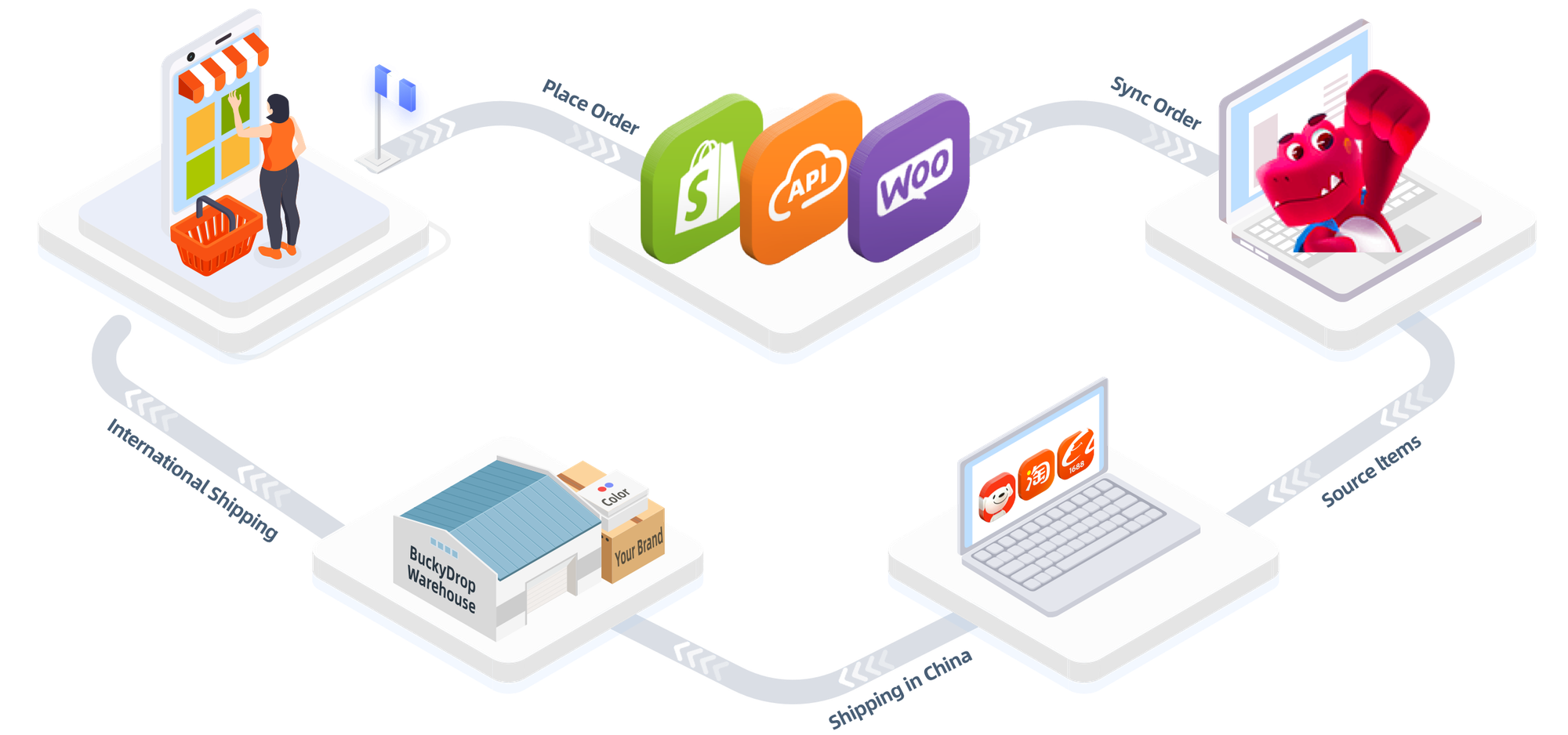
In this workflow, BuckyDrop sits between your store and the China-side tasks most North American sellers do not want to manage order by order.
Based on public listings and company-provided materials, BuckyDrop is positioned for China sourcing, Shopify and WooCommerce workflows, warehouse receiving, quality checks, package handling, branded packaging, international logistics, and order/tracking synchronization. BuckyDrop’s official website states that it sources from Chinese platforms including 1688, Taobao, Tmall, Xianyu, JD, Poizon, and Weidian through its dropshipping services.
For Shopify sellers, the operational issue is often china fulfillment: receiving, QC, packing, carrier handoff, tracking, and exceptions. Public listings show BuckyDrop has a Shopify App Store listing and a WooCommerce plugin listing.
For Xianyu specifically, sellers should verify current service scope before scaling. Ask what product categories are supported, what inspection includes, how failed inspections are handled, what fees apply, which shipping lines are available, and how tracking returns to Shopify or WooCommerce.
BuckyDrop may help reduce manual steps depending on your setup, but it does not remove your responsibility. You still own the customer promise: product condition, delivery wording, refund policy, and support replies.
Before vs. After Workflow

Workflow Area | Without a China-side Workflow | With BuckyDrop, Subject to Verified Setup |
Product sourcing | Manually search and coordinate every order | Submit or manage sourcing through a structured platform workflow |
Seller communication | Handle Chinese-language details yourself or hire help | Use BuckyDrop’s sourcing process where applicable |
China receiving | Need your own local receiving address or agent | Use BuckyDrop warehouse receiving based on service scope |
Inspection | Arrange separately or skip it | Request quality checks where available and confirm inspection rules |
Store order handling | Copy-paste orders manually | Use Shopify / WooCommerce workflow support, depending on setup |
Tracking | Upload manually or chase agents | Use tracking sync where supported and configured |
Exceptions | Handled ad hoc | Define rules for failed inspection, stockout, seller cancellation, and delays |
This is not a claim that every Xianyu order becomes automatic. It is a framework for deciding whether a sourcing and fulfillment partner can make the workflow controlled enough to test.
Step-by-Step Workflow: How to Dropship Xianyu Products Overseas with BuckyDrop

Step 1: Choose the niche before the product
Start with the customer, not the marketplace. Are you selling to collectors, vintage fashion buyers, anime fans, home office shoppers, or bargain hunters?
Each group has a different tolerance for pre-owned condition, delivery time, and price. If your audience expects Amazon-like delivery and easy returns, Xianyu may be a poor fit.
Step 2: Find potential Xianyu products
Treat Xianyu as a drop sourcing channel, not a plug-and-play supplier catalog.
Search for products that match your niche and margin target. Do not pick only the cheapest listing. Look for clear photos, detailed descriptions, seller responsiveness, visible condition, and enough product value to cover international shipping.
Save multiple options. One-off inventory means you need substitutes.
Step 3: Check condition and seller details
Before listing anything, confirm condition details. Look for wear, missing accessories, packaging damage, stains, scratches, model numbers, size, measurements, and compatibility.
For pre-owned products, your store listing should not hide the condition. Clear disclosure may lower conversion slightly, but it can reduce disputes later.
Step 4: Estimate landed cost

Calculate the full cost before listing:
Product price + China domestic shipping + sourcing or service fees + inspection fees if applicable + warehouse or package handling fees + international shipping + payment processing + refund allowance + ad spend per order.
If the margin only works when everything goes perfectly, it probably does not work.
Step 5: Submit or manage the sourcing request
Use BuckyDrop’s workflow where applicable. Confirm what information is required before scaling: product link, variant, seller notes, condition requirements, acceptable substitutions, inspection requests, packaging rules, and shipping preferences.
For Shopify sellers, automated order fulfillment matters most once manual copy-paste ordering starts creating delays.
Step 6: Receive, inspect, and decide

For Xianyu, inspection should be treated as a risk-control step, not a cosmetic add-on.
BuckyDrop materials describe warehouse receiving, product checks, quality inspection, package handling, and related fulfillment services. However, sellers should confirm what the inspection covers before listing condition-sensitive products: photos, accessories, model number, visible wear, packaging damage, functionality checks, rejection rules, and any extra fees.
Do not assume every used product can be fully verified from a basic inspection.
Step 7: List accurately on Shopify or WooCommerce
Write your own product description. Do not copy a machine-translated Xianyu title.
Use clear condition wording: “pre-owned,” “open-box,” “minor visible wear,” “inspected before shipment,” or “one-of-one item” when accurate.
WooCommerce sellers should also understand how order status, shipment tracking, and customer shipping communication work in the WooCommerce order fulfillment documentation.
Step 8: Fulfill a test batch
Do not point a live ad campaign at an untested Xianyu item. Run 10–20 real orders first.
Measure four things: purchase success rate, inspection pass rate, tracking return speed, and customer support workload. If customers start asking “Where is my order?” before tracking updates, your delivery promise or communication flow needs work.
Step 9: Review exceptions before scaling
The real test is what happens when the seller cancels, the item fails inspection, the variant is wrong, or tracking does not update for several days.
Do not scale because the first order arrived. Scale only if the workflow survives exceptions.
Manual Xianyu Sourcing vs. Using BuckyDrop
Workflow Area | Manual Xianyu Sourcing | Using BuckyDrop |
Chinese seller communication | You handle it or hire help | BuckyDrop may assist through its sourcing workflow |
Local payment and purchase | Often difficult for overseas sellers | Managed through platform workflow, subject to current service terms |
China receiving address | You need your own receiving setup | BuckyDrop provides China-side receiving based on service scope |
Product inspection | You arrange separately or skip | QC options are described in public and company materials |
Shopify / WooCommerce workflow | Mostly manual unless custom-built | Public listings show Shopify and WooCommerce app/plugin presence |
Tracking return | Manual upload or third-party process | Tracking sync should be verified during setup |
Best for | Personal buying or very small tests | Sellers who need repeatable fulfillment workflow |
Main risk | Too much manual work | Must verify fees, service limits, and workflow fit before scaling |
Once you are managing paid orders rather than personal purchases, dropshipping fulfillment services should be evaluated by order sync, QC options, tracking return, exception handling, and real cost per fulfilled order.
What to Verify Before You Commit
Before you scale Xianyu sourcing, verify the workflow in writing:
· Can the product be purchased reliably, or is it one-off inventory?
· What happens if the Xianyu seller cancels or changes the listing?
· What does inspection include: photos, accessories, model number, visible wear, packaging, or functionality?
· Who decides whether a failed item is rejected, replaced, discounted, or shipped anyway?
· How are SKU and variant details matched to Shopify or WooCommerce orders?
· How quickly does tracking return to the store after shipment?
· What fees apply for sourcing, inspection, storage, packaging, branded inserts, and international shipping?
· What support channel handles fulfillment exceptions?
· What customer-facing delivery promise can you safely make?
If these answers are unclear, keep the product in testing mode.
Cost, Time, and Risk Factors
Do not list a Xianyu product until you understand the full cost structure.
Pricing may vary, so verify with the provider before scaling. At minimum, review:
· Product cost
· China domestic shipping
· Sourcing or service fees
· Inspection cost if applicable
· Warehouse or package handling cost
· International shipping
· Packaging or branding requests
· Payment fees
· Refund and replacement allowance
· Customer support workload
Be careful with delivery promises. For U.S. ecommerce sellers, the FTC Mail, Internet, or Telephone Order Merchandise Rule requires sellers to have a reasonable basis for advertised shipping times. If no shipping time is stated, the rule generally uses a 30-day standard.
For North American buyers, tracking expectations are shaped by Amazon, USPS, UPS, FedEx, and local carrier scans. If your store collects payment today but tracking does not return for several days, support tickets may start before the parcel leaves China.
That is why Xianyu products should be tested before Q4, Black Friday / Cyber Monday, or any paid traffic push. You are not just testing whether the item can be purchased. You are testing whether the customer promise survives inspection, packing, export shipping, and the first “Where is my order?” email.
Example Workflow for a North American Shopify Seller
This is an example scenario, not a reported customer result.
A Shopify seller in California runs a niche store for vintage-style accessories. They find several Xianyu listings for pre-owned bags and unique hair accessories that are visually strong enough for TikTok content.
Instead of listing 50 items immediately, they select five products and submit sourcing requests through BuckyDrop. Before listing, they confirm whether condition checks are available, what photos can be reviewed, and what happens if the item fails inspection.
They calculate landed cost and decide not to list two items because international shipping would make the final price too high. Three products pass the margin check.
The seller lists the products with clear condition notes: “pre-owned,” “minor visible wear,” or “open-box.” They set a conservative delivery expectation and prepare customer support replies for tracking questions.
After 10–20 orders, they review the numbers. If purchase success is low or customers complain about condition, they stop. If inspection pass rate, tracking return, and support workload look manageable, they add similar products.
That is the right way to test Xianyu: small batch, clear expectations, operational review before scaling.
Common Mistakes to Avoid
The first mistake is treating the Xianyu listing price as your product cost. It is only the starting point. Your real cost includes sourcing, fulfillment, inspection, shipping, support, and refunds.
The second mistake is hiding product condition. If an item is used, say so. A lower conversion rate is better than chargebacks.
The third mistake is assuming inventory stability. Xianyu often works better for limited drops, curated collections, or one-off sourcing than evergreen SKU campaigns.
The fourth mistake is using vague delivery promises. If your product page says “fast shipping” but tracking does not return quickly, you will create support tickets.
The fifth mistake is scaling ads before testing fulfillment exceptions. A product that works at two orders can fail at 50 if seller response, inspection, or shipping breaks down.
Pre-Listing Checklist
Check | Question |
Product fit | Does the item match a niche where uniqueness matters? |
Condition | Can condition be verified before shipping? |
Listing accuracy | Can you describe the item without overpromising? |
Margin | Does landed cost still leave room after ads and refunds? |
Inventory | Is this one-off, limited, or repeatable? |
Fulfillment | Who handles purchase, receiving, QC, packing, and shipping? |
Tracking | How quickly will tracking return to the store? |
Support | What will you say when customers ask, “Where is my order?” |
Returns | What is your policy if the item arrives as described but the customer changes their mind? |
Scale decision | Have you tested 10–20 orders before increasing spend? |
FAQ
1. Can foreigners buy directly from Xianyu?
Some overseas users may find ways to buy from Xianyu through local payment methods, forwarding addresses, agents, or Chinese contacts. For ecommerce operations, direct buying can become difficult because you still need seller communication, payment, receiving, inspection, and international shipping. If you are running Shopify or WooCommerce orders, a sourcing and fulfillment workflow is usually more practical than personal buying.
2. Is Xianyu better than AliExpress for dropshipping?
Not universally. Xianyu may be better for rare, second-hand, discontinued, local Chinese, or niche products. AliExpress is often easier for standardized export-facing products. Use Xianyu when product uniqueness creates the value. Use more standard suppliers when you need stable inventory and lower operational complexity.
3. Does BuckyDrop support Shopify and WooCommerce?
Based on public materials, BuckyDrop has a Shopify App Store listing and a WooCommerce plugin listing. Company-provided materials also mention API and BuckyShop support. Feature availability, setup flow, order sync behavior, tracking sync, and API scope should be verified before scaling, especially if you use custom stores, TikTok Shop, Amazon, or marketplace workflows.
4. Can BuckyDrop inspect Xianyu products before shipping?
Company-provided materials describe warehouse receiving, product checks, quality inspection, package handling, and related fulfillment services. The exact inspection scope, cost, rejection rules, and turnaround may vary by product and service level. Confirm the inspection checklist with BuckyDrop before listing condition-sensitive products.
5. What should I test before using Xianyu products for paid ads?
Test 10–20 orders before serious ad spend. Measure purchase success rate, inspection pass rate, cost per fulfilled order, tracking return speed, customer support tickets, refund requests, and gross margin after shipping. Do not scale only because the product looks cheap.
6. Is Xianyu suitable for beginners?
It can be risky for beginners because condition, stockouts, Chinese seller communication, and fulfillment exceptions require judgment. A beginner with a clear niche and a small test budget can experiment, but Xianyu is not the easiest first sourcing channel. Beginners should start with low-risk products and avoid used electronics, luxury-branded goods, fragile items, and regulated categories.
7. Can I use Xianyu products for WooCommerce, TikTok Shop, Amazon, or custom stores?
WooCommerce support is reflected in BuckyDrop’s public plugin listing. Shopify support is reflected in its app listing. For TikTok Shop, Amazon, API, or custom stores, verify current integration, marketplace policies, tracking requirements, and product category restrictions before listing. Do not assume a product that works on your own website is allowed on every marketplace.
8. How should I describe used Xianyu products on my store?
Be direct. Use terms like “pre-owned,” “open-box,” “minor visible wear,” “inspected before shipment,” or “one-of-one item” when accurate. Include photos and avoid stock-image-only listings for condition-sensitive products. Accurate wording can reduce refund pressure and payment disputes.
9. What products should I avoid sourcing from Xianyu?
Avoid products with high compliance risk, unclear authenticity, high breakage risk, heavy dimensional weight, or condition that cannot be verified. Be especially careful with cosmetics, supplements, baby products, safety products, batteries, used electronics, luxury-branded goods, and fragile home goods.
10. How do I know if the economics work?
Build a landed cost model. Include product cost, domestic shipping, sourcing or service fees, QC, packaging, international shipping, payment fees, ad spend, refunds, and support time. If your margin disappears after one refund or one failed inspection, do not scale the product.
Final Recommendation
Xianyu is worth testing if your store competes on curation, rarity, niche taste, or access to China-local products. It is not the right channel if your business needs predictable replenishment, uniform product condition, or low-touch fulfillment at scale.
For North American Shopify and WooCommerce sellers, the safest path is to start small. Choose five to ten products, run 10–20 test orders, and measure what actually happens: purchase success rate, inspection results, tracking return speed, customer support workload, refund pressure, and cost per fulfilled order.
Connect your Shopify or WooCommerce store with BuckyDrop and test your next 10–20 Xianyu-sourced orders before scaling. Start with products where condition can be verified, shipping weight is manageable, and margin still works after sourcing, inspection, packaging, international shipping, payment fees, and support time.
After the test batch, review five numbers: purchase success rate, QC pass rate, tracking return speed, customer support tickets, and real cost per fulfilled order. If the workflow holds up, add more Xianyu products gradually. If it creates too many exceptions, move that product idea to a more stable sourcing channel.
Sources
2. BuckyDrop Shopify App Store listing
3. BuckyDrop WooCommerce plugin listing
4. Xianyu / Goofish official site
6. WooCommerce order fulfillment documentation
7. FTC Mail, Internet, or Telephone Order Merchandise Rule
8. Google Search Central: helpful, reliable, people-first content
9. Source: company-provided BuckyDrop overview document