7 Best Print on Demand Alternatives for Dropshipping in 2026

Quick Verdict
Stay with POD when the design or personalization is the product, demand remains difficult to predict, and the current margin can absorb production errors, replacements, and customer support.
Change POD providers when the model still works but the current blank, printing method, production location, catalog, or integration does not.
Move beyond POD when the fixed catalog, per-order production cost, supplier visibility, packaging limits, or fulfillment exceptions are the actual constraint.
Depending on the store, the next step may be:
· Conventional dropshipping for broader product testing
· A North American supplier for regional stock and returns
· A sourcing and fulfillment partner for supplier-side coordination
· White label or private label for stronger differentiation
· Wholesale inventory and a 3PL for proven products
· A hybrid model for stores with both experimental and repeat-selling SKUs
None of these models is automatically better. The right choice depends on where margin, control, or customer experience is currently breaking down.
What Counts as a Print on Demand Alternative?
Print on demand is a specialized form of dropshipping. The supplier produces or customizes an item after the customer orders and ships it without the seller holding finished inventory. Shopify’s comparison of print on demand and dropshipping identifies customization, product selection, branding, competition, and return handling as major differences between the models.
When sellers search for POD alternatives, they are often describing one of two failures.
The provider is the problem
The designs still sell, but the current provider has the wrong products, print methods, production regions, packaging options, or store integration.
In that case, another POD provider may be enough. Shopify’s 2026 guide to print-on-demand companies notes that providers differ in product catalogs, design tools, shipping policies, and pricing structures.
The operating model is the problem
Per-order production may leave insufficient margin. The fixed catalog may limit the brand. Supplier-side visibility may be too weak. Packaging, inspection, returns, or international fulfillment may require more control than a standard POD workflow provides.
In that case, moving from one POD app to another may only relocate the same constraint.
Why Ecommerce Sellers Move Beyond POD
POD keeps cash out of finished inventory, but it shifts risk into per-order cost, supplier dependency, and exception handling.
Most stores begin looking elsewhere for one of three reasons.
Margin and acquisition pressure
A product may look profitable before Meta or TikTok ad spend, refunds, payment disputes, replacements, and staff time are included.
The useful number is not the supplier’s quoted unit price. It is the cost per fulfilled order:
Product cost + customization + packaging + handling + shipping + duties or taxes + payment fees + expected refund and replacement cost + manual labor
A provider that saves $3 on the product but creates two additional support contacts per order may not be cheaper.
Product and branding limits
POD works well when original artwork is the main value. It becomes restrictive when customers want a different material, product specification, accessory, bundle, label, or packaging experience.
Apparel sellers should first decide whether they need another printer or a broader custom apparel dropshipping workflow involving fabric selection, labels, packaging, and supplier coordination.
Stores focused on dropshipping t shirts should test the actual blank, fabric weight, sizing tolerance, print durability, and wash performance instead of approving a product from supplier mockups alone.
Fulfillment and support workload

Operational problems often appear after the order enters the supplier workflow:
· A paid order does not sync.
· A storefront SKU maps to the wrong supplier variant.
· One item in a mixed cart is out of stock.
· Tracking does not return to the store.
· The customer changes the address after payment.
· A parcel is returned to the sender.
· A branded insert is missing.
· The customer files a chargeback before the carrier completes delivery.
These failures create refund pressure and ad-spend waste even when the product itself is acceptable.
How to Compare Print on Demand Alternatives?

Use the same scorecard for every option. Otherwise, a low unit price can hide shipping, replacement, and labor costs.
Evaluate:
1. Product range: Fixed POD catalog, supplier marketplace, custom manufacturing, or stocked inventory
2. Inventory exposure: No stock, prepaid packaging, MOQ, or full wholesale commitment
3. Branding control: Labels, inserts, packaging, materials, specifications, and exclusive variants
4. Quality control: Samples, receiving checks, approved specifications, and defect handling
5. Integration depth: Order sync, SKU mapping, stock updates, tracking return, and cancellations
6. Shipping workflow: Origin, carrier handoff, customs, last-mile tracking, and destination coverage
7. Returns: Return address, inspection, restocking, replacement approval, and financial responsibility
8. Operational workload: Manual purchasing, supplier messages, spreadsheets, and exception management
9. Scaling path: Ability to move from testing into private label, bulk production, or regional inventory
Seven Print on Demand Alternatives Compared
Alternative | Best Fit | Inventory Exposure | Branding Control | Main Tradeoff |
Another POD provider | Design-led stores with a supplier problem | Low | Medium | The store remains limited by a POD catalog |
Conventional dropshipping | Broad, low-commitment product testing | Low | Low | Competing stores may sell identical products |
North American supplier network | Regional stock, returns, or carrier access | Low to medium | Low to medium | Product cost or selection may be less competitive |
China sourcing and fulfillment partner | Supplier coordination and broader sourcing | Low to medium | Medium to high | Cross-border variables require testing |
White label or private label | Validated products that need differentiation | Medium | High | Samples, packaging, MOQs, or inventory may apply |
Wholesale inventory plus 3PL | Stable, predictable repeat sellers | High | High | Forecasting and unsold inventory risk |
Hybrid POD and inventory | Stores with both new and proven products | Mixed | High | More complex routing and SKU management |
1. Another POD Provider
Switch providers when the designs still sell but the current blank, print method, production region, or integration is causing the problem.
This route keeps inventory exposure low and avoids rebuilding the entire supply chain. It may also provide access to different apparel brands, printing techniques, product categories, or regional production facilities.
It will not solve a store that has outgrown per-order production or the available POD catalog.
Before switching, order samples using the exact:
· Product
· Size
· Color
· Print location
· Artwork file
· Packaging option
· Destination country
Wash apparel samples and compare measurements before and after laundering. Also ask how the provider handles misprints, lost parcels, address changes, and customized-product returns.
2. Conventional Product Dropshipping
Consider conventional dropshipping when the store needs a wider range of ready-made products and wants to test demand without purchasing stock.
The advantage is catalog flexibility. The disadvantage is weak product exclusivity. Other stores may use the same supplier photos, specifications, and products.
Shopify and WooCommerce sellers should verify stock synchronization, variant matching, order routing, and tracking return before importing a large catalog.
The official WooCommerce Dropshipping documentation describes supplier assignments, automated supplier notifications, packing slips, and supplier inventory CSV imports. Actual behavior still depends on the extension and supplier workflow being used.
This option is not ideal when proprietary artwork or product design is the store’s main competitive advantage.
3. North American Supplier Networks
A US or Canadian supplier may make sense when regional stock, return handling, and recognizable carrier scans matter more than maximum product variety.
A regional supplier may reduce time-zone friction and cross-border handoffs, depending on where the inventory is actually stored and fulfilled.
Verify the physical inventory location. A supplier can be headquartered in North America while shipping certain SKUs from overseas.
Ask:
· Is stock updated in real time or by periodic file?
· Does the supplier ship through USPS, UPS, FedEx, Canada Post, or another carrier?
· Where are returns sent?
· Can Canadian customers face duties or brokerage charges?
· How are address corrections and returned-to-sender parcels handled?
· Does each product have the same fulfillment origin?
Do not assume “US supplier” means every order ships domestically.
4. China Sourcing and Fulfillment Partners
This model becomes relevant when the problem begins after the customer clicks “Buy.”
The store may be copying orders into supplier chats, checking variants manually, waiting for several sellers to send products to different locations, and then copying tracking numbers back into Shopify or WooCommerce.
Broader dropshipping fulfillment services may coordinate:
· Product sourcing and supplier purchasing
· Receiving
· Quality checks
· Product consolidation
· Labeling or packaging requests
· Package processing
· International shipping
· Tracking synchronization
This can provide more supplier-side visibility than a fixed product catalog. It does not guarantee a lower landed cost or eliminate supplier availability, product compliance, or logistics exceptions.
Sellers should test the exact product, supplier, packaging request, destination, and shipping route before scaling paid traffic.
5. White Label or Private Label Dropshipping、
White label is generally the lower-commitment option. The supplier provides an existing product, while the seller adds branding such as a label, insert, packing slip, or package.
Private label can involve changes to the product itself, including materials, dimensions, colors, features, accessories, formulas, tooling, or permanent labels.
A private label dropshipping model becomes more relevant after a SKU shows repeatable demand and customers have identified a product change worth making.
Before committing, verify:
· What physically changes from the standard product?
· Can other buyers purchase the same specification?
· Who owns the artwork, tooling, mold, or production files?
· Does the MOQ apply per product, size, color, or design?
· Must packaging or components be prepaid?
· What happens to unused branded materials?
· How are production units checked against the approved sample?
Private label does not automatically produce a better margin. Samples, production deposits, packaging, inspection, storage, shipping, refunds, and replacements must be included.
6. Wholesale Inventory Plus a 3PL

Stocked inventory begins to make sense when a product has repeat demand across more than one campaign or replenishment cycle.
A third-party logistics provider can receive inventory, store it, pick and pack orders, ship parcels, and sometimes process returns. Shopify’s guide to third-party logistics distinguishes fulfillment operations from broader logistics and supply-chain responsibilities.
A 3PL does not find products, negotiate with factories, or validate demand for you.
Before moving inventory, calculate:
· Weeks of stock on hand
· Reorder lead time
· Storage fees
· Q4 or Black Friday/Cyber Monday surcharges
· Pick-and-pack charges
· Slow-moving SKU exposure
· Return inspection and restocking fees
· Inventory disposal or removal costs
Do not move a product into stock because of one short Meta or TikTok spike.
7. Hybrid POD and Inventory
A hybrid model is often the most practical path for a growing design-led store.
Keep new, seasonal, or low-volume designs on POD. Move only repeat sellers into sourced production, private label, wholesale inventory, or regional fulfillment.
This protects cash while allowing proven products to use a different cost structure.
The risk is operational complexity. A hybrid store needs clear:
· SKU naming
· Variant mapping
· Fulfillment-location assignments
· Mixed-cart rules
· Inventory buffers
· Customer delivery messaging
· Return-routing instructions
Introduce the model one product family at a time. A complicated workflow can erase the savings it was meant to create.
Before and After: Manual Supplier Workflow vs. Fulfillment Partner
Workflow Step | Manual Supplier Setup | Sourcing and Fulfillment Partner |
Order intake | Staff copy order and address data | Eligible orders may sync from the connected store |
Supplier purchasing | Each supplier is contacted or paid separately | Purchasing may be coordinated through one workflow |
SKU verification | Staff manually check each variant | SKU mapping can automate routing but still requires testing |
Incoming checks | Often unavailable before direct shipment | Products may be received and checked before packing |
Consolidation | Multiple suppliers may ship separately | Items may be combined before international shipment |
Tracking | Staff copy numbers into the store | Tracking updates may sync back to the storefront |
Exceptions | Managed across chats and spreadsheets | Centralized visibility may help, but exceptions still need review |
The important word is may. Automation depends on correct product mapping, supplier data, integration settings, and the actual service being used.
Shopify and WooCommerce Switching Risks
Installing an app is not the same as completing a fulfillment integration.
Before enabling automated order fulfillment, test:
1. SKU and variant matching
2. Product-source binding
3. Stock and price updates
4. Shipping-zone behavior
5. Mixed-cart routing
6. Address edits and cancellations
7. Partial or split shipments
8. Out-of-stock handling
9. Tracking return
10. Refund and replacement responsibility
WooCommerce’s current order-fulfillment documentation supports partially fulfilled order states, tracking information, customer notifications, and major carriers including UPS, FedEx, DHL, and USPS. Plugins and external integrations can extend or alter that behavior.
North American sellers should test the exact carrier path they plan to advertise. An international tracking number is not the same as a usable USPS, UPS, FedEx, or Canada Post acceptance scan.
Record:
· When the paid order enters fulfillment
· When the supplier confirms the correct variant
· When tracking appears in the store
· When the carrier records movement
· When the customer can track the parcel without contacting support
· What happens during a cross-border or last-mile handoff
US sellers should also avoid publishing firm shipment promises without operational evidence. Under the FTC Mail, Internet, or Telephone Order Merchandise Rule, sellers need a reasonable basis for the advertised shipment timeframe. If shipment cannot occur as promised, the rule addresses customer consent to delay or refunds for unshipped merchandise.
Canadian shipping, duties, labeling, consumer protection, and return requirements should be reviewed separately for the relevant product and province.
What to Verify Before You Commit

Run the test under real customer conditions, not only with one sample shipped to your own address.
A practical initial test is 10 to 20 eligible orders. This is enough to expose common workflow failures, but it does not prove long-term reliability or peak-season capacity.
Include:
· At least two product variants
· A multi-item order
· More than one US shipping region
· A Canadian order if Canada is a target market
· An address correction or cancellation request
· A branded packaging instruction, if applicable
· An out-of-stock or substitution question
· A replacement or damage scenario
Set the pass criteria before the first order.
Measure:
Test Area | What to Record |
Order sync | Whether the paid order enters the correct queue |
Variant accuracy | Whether SKU, size, color, and quantity match |
Supplier processing | Time from order confirmation to package preparation |
Quality visibility | What evidence or status is available before shipment |
Packaging | Whether instructions and materials are applied correctly |
Tracking return | When usable tracking appears in the store |
Delivered cost | Product, packaging, handling, shipping, duties, and fees |
Manual workload | Staff minutes required per order and exception |
Customer support | WISMO, address, refund, and damage contacts |
Replacements | Approval process, cost, and responsibility |
Expand volume only if the workflow meets the accuracy, cost, tracking, and exception-handling thresholds defined before the test.
Common Mistakes When Replacing POD
Switching providers before diagnosing the bottleneck
A different printer cannot solve a fixed-catalog problem. A sourcing partner cannot rescue an unprofitable product.
Comparing only the product quote
Packaging, inspection, handling, shipping, duties, refunds, replacements, and staff time belong in the calculation.
Moving every SKU at once
Begin with one product family. Keep a rollback option while the new workflow is being tested.
Approving products from mockups
Order physical samples. For apparel, measure, wear, and wash them.
Scaling advertising before testing fulfillment
A successful campaign can turn a weak workflow into a larger manual queue, more refund requests, and more expensive mistakes.
Ignoring returns and compliance
Confirm return locations, damaged-item responsibility, labeling, product documentation, and destination-market requirements before selling at volume.
Where BuckyDrop Fits—and Where It Does Not
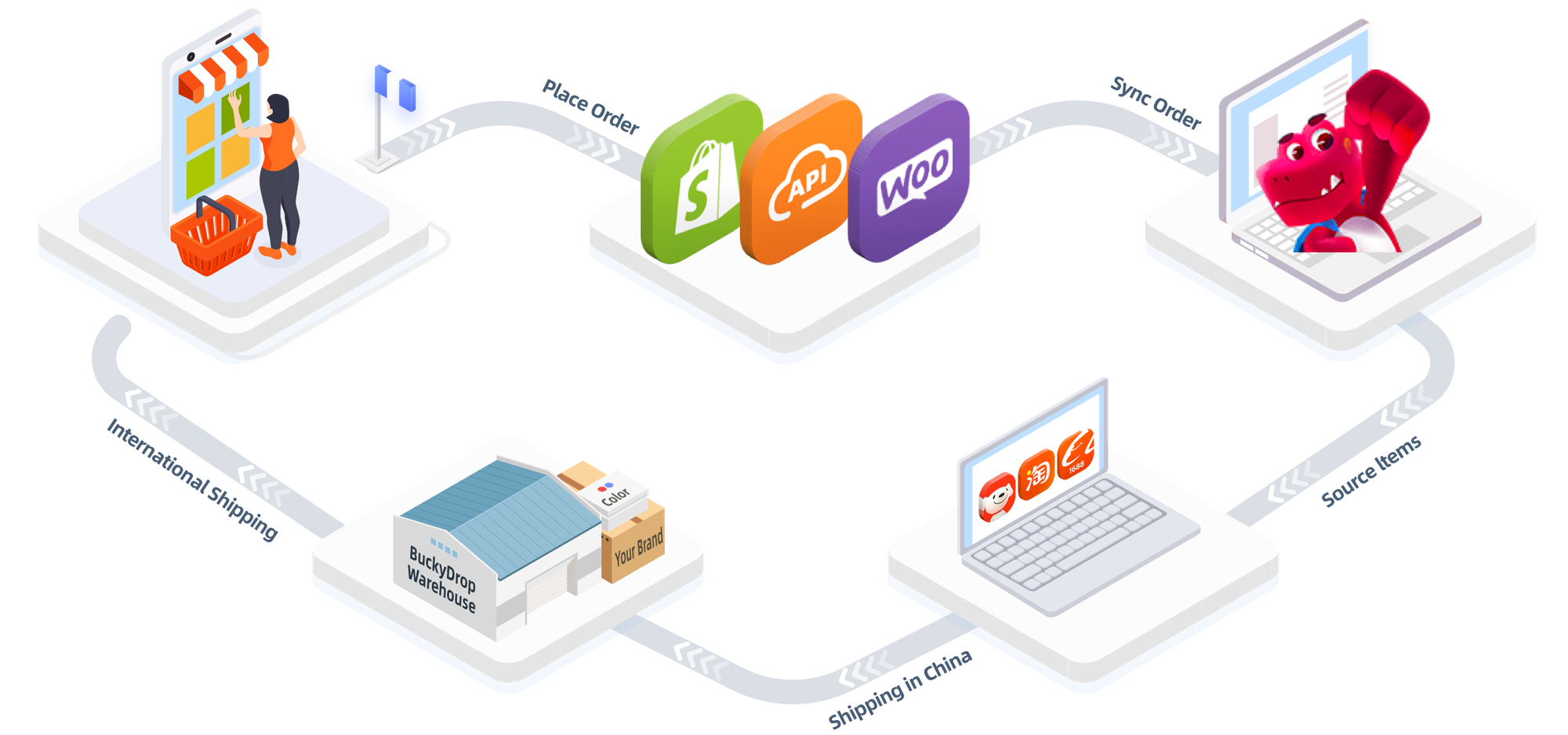
BuckyDrop fits stores whose bottleneck sits between the Shopify or WooCommerce order and the international shipment: supplier purchasing, incoming checks, SKU matching, package preparation, and tracking return.
Based on BuckyDrop’s public sourcing and fulfillment workflow, the service supports Shopify and WooCommerce order synchronization, sourcing from Chinese marketplaces, quality checks, value-added services, package processing, international shipping, and tracking synchronization.
Its current Shopify App Store listing also lists WooCommerce API integration, private label, white label, custom packaging, quality checks, automated fulfillment, and order tracking. Features, plans, external charges, and service availability may change, so verify the exact product and workflow before scaling.
BuckyDrop may fit sellers who need:
· Broader access to Chinese suppliers
· Purchasing and supplier follow-up
· Receiving and quality checks
· Product consolidation
· Packaging or labeling coordination
· Shopify or WooCommerce order automation
· Cross-border package processing and tracking
It may be a weaker fit when the seller:
· Requires only US-made or locally stocked products
· Needs a domestic North American 3PL
· Has not validated any product demand
· Wants only a POD mockup generator
· Requires a fixed service commitment not confirmed in public materials
· Sells a regulated product without completing compliance review
· Is unwilling to approve samples or monitor fulfillment performance
BuckyDrop is not a substitute for demand validation, a customer-facing return policy, product compliance review, or product-specific cost analysis.
Frequently Asked Questions
Is print on demand the same as dropshipping?
POD is a specialized form of dropshipping. The supplier produces or customizes the item after the order and ships it directly to the customer. Conventional dropshipping usually involves existing, ready-made products.
What is the best alternative to print on demand?
There is no universal winner. Another POD provider may solve a supplier issue, while conventional dropshipping, sourcing partners, private label, or stocked inventory address different constraints.
Should I change POD providers or leave POD entirely?
Change providers when the designs, catalog model, and margins still work but the current supplier does not. Consider leaving the model when per-order production, fixed products, or limited supplier control is the underlying problem.
Can I combine POD and regular dropshipping in one Shopify store?
Yes. Test fulfillment-service assignments, mixed carts, split shipments, tracking notifications, cancellations, and return messaging before promoting both product types together.
Do these alternatives work with WooCommerce?
Many do, but compatibility varies. Confirm whether the provider uses a plugin, API, CSV, email workflow, or manual export. Test order status, supplier notifications, partial fulfillment, inventory, and tracking behavior.
Is private label always cheaper than POD?
No. Private label may offer different unit economics at sufficient volume, but samples, MOQs, packaging, production deposits, storage, defects, shipping, and unsold materials must be included.
Who is responsible for returns and replacements?
Responsibility varies by provider, supplier, product, and cause. Confirm who approves replacements, where returned products go, whether customized goods can be restocked, and who pays for supplier errors.
What should I test before connecting a fulfillment provider?
Test real SKUs, variants, addresses, multi-item orders, packaging instructions, out-of-stock handling, tracking return, cancellations, and replacements. Use a limited order group before moving the full catalog.
Are sourcing and fulfillment partners suitable for beginners?
They can be, but automation does not make an untested product profitable. Beginners still need to understand contribution margin, customer expectations, refund policies, product compliance, and supplier risk.
Final Recommendation
The right choice among these print on demand alternatives depends on the step currently leaking margin or creating customer support work.
Do not replace POD because another platform advertises a lower unit price. Determine whether the problem is:
· The current provider
· Per-order production
· Product selection
· Branding control
· Supplier visibility
· Shipping and tracking
· Returns
· Inventory strategy
Then test one product family before changing the full store.
If supplier coordination, quality checks, package processing, and cross-border fulfillment are the current bottlenecks, create a BuckyDrop account and route the next 10 to 20 eligible Shopify or WooCommerce orders through the workflow.
Compare five things with the current setup:
1. Variant accuracy
2. Manual handling time
3. Tracking return
4. Packaging execution
5. Total cost per fulfilled order
Increase volume only if the test meets the thresholds defined in advance.
Sources
1. Shopify: Print on Demand vs. Dropshipping
2. Shopify: Best Print-on-Demand Companies in 2026
3. Shopify: Third-Party Logistics and Ecommerce Fulfillment
4. WooCommerce Dropshipping Documentation
5. WooCommerce Order Fulfillment Documentation
6. Federal Trade Commission: Mail, Internet, or Telephone Order Merchandise Rule