Best Home Decor Dropshipping Suppliers in 2026: How to Source Affordable Products from China

Quick Verdict: Match the Supplier to the Product Risk
Do not choose one supplier for an entire home decor catalog by default.
A supplier that works well for pillow covers may be a poor choice for mirrors, lamps, ceramic products, or oversized furniture.
Your Main Requirement | Supplier Model to Consider | Products That May Fit | Main Issue to Verify |
Original designs and personalization | Print-on-demand provider | Wall art, pillow covers, blankets | Unit cost and branding limitations |
Regional product discovery | US, Canadian, or European supplier marketplace | Textiles, storage products, small accessories | Exact SKU origin and return address |
Broad catalog testing | General dropshipping marketplace | Lightweight decor and seasonal accessories | Supplier consistency |
China-wide product sourcing | China sourcing and fulfillment provider | Products found on 1688, Taobao, or other Chinese marketplaces | Landed cost, packaging, and inspection |
Heavy or highly fragile products | Local wholesaler or domestic warehouse | Mirrors, large lamps, furniture | Inventory commitment and final-mile cost |
Use a print-on-demand provider when the design is the product. Consider a domestic or regional supplier when the item is oversized, highly fragile, difficult to return, or tied to a short delivery promise.
A China sourcing and fulfillment provider becomes more relevant when you have found specific products on domestic Chinese marketplaces and need help with purchasing, receiving, inspection, consolidation, repacking, and individual order fulfillment.
The correct choice is the option that can deliver the exact variant, with acceptable packaging and traceable fulfillment, at a cost that survives refunds and replacement orders.
How to Evaluate Home Decor Dropshipping Suppliers
Catalog size matters less once an order is paid. The real test is whether the correct variant ships, tracking returns to the store, and damage claims are resolved without creating a manual fulfillment queue.
Product fit
Confirm that the supplier carries products matching your store’s design direction, material expectations, target retail price, and customer profile.
A broad catalog can be useful for research, but it does not guarantee consistent materials, colors, dimensions, or packaging across different suppliers.
SKU and variant accuracy
Color, size, finish, material, and pack quantity must map correctly between the supplier and your store.
Create a mapping sheet containing:
· Store SKU
· Supplier SKU
· Variant name
· Product dimensions
· Carton dimensions
· Product weight
· Shipping weight
A small mapping error can send a customer the wrong size or finish, creating a replacement order and a possible chargeback.
Inventory and order visibility
Ask how often inventory updates and what happens when a paid order becomes unavailable.
A useful drop sourcing process should show whether an order has been accepted, paid, purchased, received, inspected, packed, shipped, delayed, or canceled.
Packaging and damage handling

Textiles, wall prints, ceramic products, mirrors, framed art, and lamps should not use the same supplier-approval standard.
For fragile products, ask for photographs of:
· Inner protection
· Product positioning
· Corner protection
· Empty-space filling
· Outer carton
· Shipping label placement
Also confirm who pays for the product, replacement shipping, and customer refund when an item arrives damaged.
Real cost per fulfilled order
The supplier’s listed price is not the number that determines your margin.
Calculate:
Product cost + local handling + inspection + packaging + international shipping + payment fees + expected replacement cost
You should also account for discount codes, Meta or TikTok ad spend, customer-support time, Shopify chargebacks, and PayPal disputes.
Home Decor Supplier Comparison
This table is a starting point for supplier research, not a final ranking. Features, pricing, product availability, and integrations may change, so verify the exact product and service before scaling.
Provider | Operating Model | May Suit | Main Limitation | What to Verify |
Printful | Print on demand | Original wall art, pillows, selected textiles | Some home decor products cannot use custom packaging or pack-ins | Product availability, sample quality, branding limits |
Spocket | Supplier marketplace | Merchants researching regional suppliers | Shipping origin and policies vary by supplier | Exact SKU origin, inventory sync, return address |
Syncee | Supplier marketplace and order management | Stores comparing multiple supplier catalogs | Refunds and returns depend on the individual supplier | Supplier terms, stock updates, tracking workflow |
Modalyst | Dropshipping marketplace | Shopify stores researching US and international suppliers | Marketplace quality depends on the underlying vendor | Supplier location, product quality, shipping terms |
CJdropshipping | China sourcing and fulfillment | Lightweight product testing and custom packaging research | Service scope depends on the product and route | Integration, packaging cost, sourcing availability |
BuckyDrop | China sourcing and automated fulfillment | Multi-platform China sourcing, inspection, branded packaging, Shopify or WooCommerce workflows | Not automatically suitable for short domestic delivery promises or untested fragile goods | Fees, product restrictions, inspection scope, shipping routes |
Supplier Options to Consider
Printful: A POD Option for Original Designs
Printful may suit stores where the design itself creates the value, such as original wall art, personalized pillows, or selected home textiles.
It is less relevant when the business depends on finding finished physical products from multiple manufacturers.
Branding also requires careful review. Printful’s current guidance states that wall art cannot use custom packaging and that several home decor categories cannot be shipped with pack-ins. Order samples before assuming that the unboxing experience matches the rest of your brand.
Spocket: A Marketplace for Regional Supplier Research
Spocket may help merchants research suppliers operating in the United States, Europe, and other regions.
The platform’s materials describe inventory, order, and tracking synchronization within supported workflows. However, the platform name alone does not tell you where an individual product ships from.
Before importing a SKU, confirm:
· Actual shipping origin
· Processing workflow
· Final return address
· Inventory-update behavior
· Supplier-specific damage policy
A “US supplier” filter should not replace checking the exact product and variant.
Syncee: A Multi-Supplier Catalog and Order Workflow
Syncee may suit merchants who want to compare several supplier catalogs and send orders through a connected marketplace workflow.
Its current documentation describes automatic order synchronization and tracking updates for supported platforms, including Shopify. Refunds, returns, and replacement decisions may still depend on the individual supplier.
That makes supplier-level due diligence essential. Do not evaluate Syncee only as a software platform; evaluate the vendor behind each product.
Modalyst: A Marketplace Option for Shopify Stores
Modalyst offers access to US and international supplier catalogs and supports Shopify product workflows.
It may be useful for merchants researching regional suppliers without contacting every vendor independently.
Before paying for a plan or importing a large catalog, search the exact home decor category and verify:
· How many relevant suppliers are currently active
· Which products ship from the target region
· Whether the vendor provides usable return terms
· Whether product and inventory updates match your workflow
CJdropshipping: A China-Based Sourcing Option
CJdropshipping may suit merchants testing lightweight China-sourced products or researching custom packaging.
Its current public materials describe sourcing, fulfillment, and customizable packaging. Specific packaging minimums, fees, product compatibility, integrations, and shipping routes should be verified for the exact product.
It is more relevant for small accessories than for mirrors, large furniture, or high-risk electrical products that have not passed packaging and compliance review.
BuckyDrop: Multi-Platform China Procurement and Fulfillment
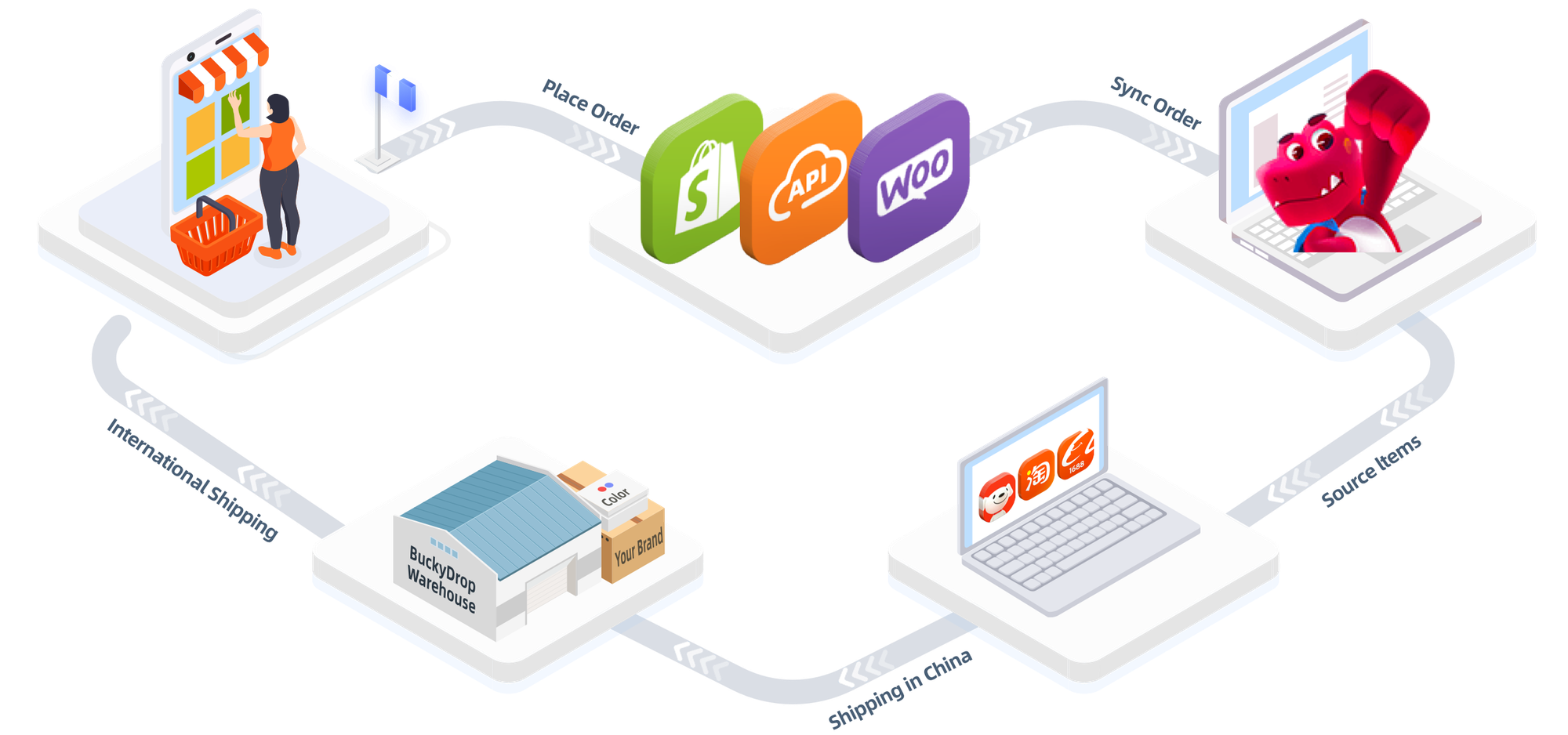
BuckyDrop becomes relevant when the operating problem is China-side purchasing and fulfillment—not simply finding another product catalog.
Its current Shopify App Store listing describes sourcing from Chinese marketplaces including 1688 and Taobao, product and supplier mapping, stock and price updates, automated order fulfillment, tracking updates, quality checks, private labeling, and custom packaging.
According to company-provided materials, BuckyDrop also supports WooCommerce and API-connected merchant workflows.
This may suit a seller who:
· Has already found products on Chinese marketplaces
· Needs a China-side team to purchase and receive products
· Wants products inspected before international shipping
· Needs orders and tracking connected to the store
· Wants to evaluate private-label or custom packaging options
It may be a weaker fit when a product requires a short domestic delivery promise, specialized regulatory documents, complex final-mile service, or a packaging design that has not passed a real shipping test.
Current fees, restrictions, inspection scope, customization requirements, and shipping options should be confirmed before scaling.
Home Decor Product Risk Matrix

A pillow cover and a framed mirror should not go through the same supplier approval process.
Product Type | Relative Fulfillment Risk | What to Test |
Pillow covers and small textiles | Lower | Fabric, stitching, color, measurements |
Posters and unframed prints | Lower | Print quality, moisture protection, tube strength |
Small storage products | Moderate | Material thickness, scratches, dimensional accuracy |
Rugs and blankets | Moderate | Weight, volumetric shipping, color variation |
Ceramic and glass decor | High | Inner protection, carton strength, damage claims |
Mirrors and framed art | High | Corner protection, glazing material, oversized fees |
Lamps and electrical decor | High | Voltage, plug type, labeling, applicable safety documents |
Large furniture | Very high | Freight, final-mile delivery, damage handling, returns |
US sellers should review the CPSC Online Sellers’ Safety Guide when importing or selling consumer products. Requirements vary by product, and importers may have testing, labeling, certification, or recordkeeping responsibilities.
Do not assume that a certificate uploaded by a supplier automatically applies to the exact product, model, material, or shipment you plan to sell.
How to Source Affordable Home Decor Products from China
Step 1: Write a usable product specification

Do not send a sourcing team only a screenshot.
Record:
· Material
· Product dimensions
· Product weight
· Finish and color
· Included components
· Target retail price
· Target destination
· Packaging requirements
· Expected test volume
If the product has variants, create a SKU mapping sheet before importing it into Shopify or WooCommerce.
Step 2: Compare the same specification
A lower price may represent a smaller product, thinner material, different finish, weaker packaging, or incomplete accessory set.
When using product sourcing tools, compare the specification rather than relying on similar product photos.
Ask whether the dimensions refer to the product itself or the shipping carton. For home decor, that difference can materially change international shipping cost.
Step 3: Calculate the landed cost

For sellers researching 1688 dropshipping, the marketplace price should be treated as the beginning of the calculation, not the final cost delivered to a customer.
Include:
· Product purchase
· China-side shipping
· Receiving and handling
· Inspection
· Repacking
· International shipping
· Import-related costs
· Payment fees
· Damage allowance
· Replacement shipping
US Customs and Border Protection recommends that new importers understand applicable procedures and product-specific requirements before importing. Review current CBP guidance for new importers or consult a qualified customs professional.
Step 4: Order and inspect samples
A sample should answer questions that supplier photographs cannot.
Check:
· Is the color close to the listing?
· Are the measurements accurate?
· Does the product have scratches, odors, or weak finishes?
· Are movable parts stable?
· Does the packaging protect vulnerable areas?
· Can the unboxing experience support your retail price?
For fragile products, request photographs before and after repacking.
Step 5: Test the store workflow
A useful test of China fulfillment is whether orders, variants, inventory, and tracking move through the workflow without repeated manual intervention.
Place test orders through the actual store checkout and check:
· Order sync
· SKU matching
· Customer address transfer
· Inventory updates
· Cancellation handling
· Out-of-stock handling
· Tracking return
· Fulfillment exceptions
Step 6: Run 10 to 20 real orders
One successful sample does not prove that the operating workflow is reliable.
As an operational test, consider starting with 10 to 20 real orders across different addresses.
Track:
· Cost per fulfilled order
· Time to the first physical carrier scan
· SKU or variant errors
· Fulfillment exceptions
· Damage claims
· Support tickets per order
· Refund and replacement cost
Sales validate demand. Delivered orders, manageable support volume, and retained margin validate the operation.
North American Fulfillment Considerations
Test the United States and Canada separately
If both countries are part of the launch, place at least one test order to each market.
Record:
· When the supplier accepts the order
· When tracking is created
· When the first physical scan appears
· Which carrier handles final-mile delivery
· Whether duties or taxes affect the experience
· How a lost or damaged parcel is handled
A tracking-number-created event is not the same as evidence that the parcel has entered the carrier network.
Canadian sellers and businesses importing products for Canadian customers should review Health Canada’s commercial import guidance. Canadian consumer-product obligations may apply to importers, advertisers, distributors, and retailers.
Be careful with shipping promises
The FTC requires US sellers to have a reasonable basis for advertised shipment timing. When a seller cannot ship within the stated time, delay and refund obligations may apply.
Review the FTC’s online order shipping guidance before publishing claims such as “ships in 48 hours” or “in stock and ships today.”
The seller remains responsible for the promise shown on the storefront, even when a third party or dropshipper handles fulfillment.
Retest before Black Friday and Cyber Monday
A workflow that performs well during a quiet month may develop stock, processing, and tracking gaps during Q4.
Before increasing Black Friday or Cyber Monday ad spend, repeat the test for:
· Inventory updates
· Order acceptance
· Processing variation
· Carrier handoff
· Exception escalation
· Refund handling
Before and After: What a Better Workflow Should Change
Manual Workflow | More Controlled Workflow |
Orders copied into supplier chats or spreadsheets | Orders transferred through a connected process |
Supplier SKU checked manually | Store and supplier SKUs mapped before launch |
Tracking pasted into Shopify | Tracking returned through the fulfillment workflow |
Stock checked after an order fails | Stock behavior tested before paid traffic scales |
Damage claims handled case by case | Claim evidence and responsibility agreed in advance |
Product costs reviewed without replacement exposure | Cost per fulfilled order includes likely exceptions |
Automation does not eliminate supplier risk. It makes exceptions easier to see, measure, and manage.
What to Verify Before You Commit
Do not approve a supplier based on a product page and a sample photo. Confirm the following in writing.
Product
Verify the exact material, dimensions, weight, finish, color tolerance, included accessories, and supplier SKU for every variant.
Packaging
Ask for photographs of the inner protection and outer carton. For glass, ceramic, mirrors, frames, and lamps, confirm corner protection, empty-space control, carton strength, and the process used when an item arrives damaged.
Inventory
Find out how often stock updates, what happens when a paid order is out of stock, and whether the supplier can substitute a materially different product without approval.
Fulfillment
Test order acceptance, address transfer, SKU matching, cancellation handling, tracking return, and fulfillment exceptions through the actual Shopify or WooCommerce checkout.
Shipping
Confirm the origin of the exact SKU, available routes, tracking milestones, final-mile carrier, remote-area charges, oversized-product fees, and lost-parcel process.
Returns and claims
Get the return address, return window, evidence requirements, damage-claim deadline, and responsibility for replacement shipping.
Compliance
Request documents relevant to the exact product and destination market. Do not accept a test report for a different model, material, or manufacturer without further verification.
A supplier that cannot answer these questions before launch is unlikely to become easier to manage after advertising volume increases.
Common Supplier Mistakes to Avoid
Choosing by unit price
The cheapest listing may produce a higher cost per delivered order after repacking, shipping, breakage, and support are included.
Importing too many SKUs
Launching 50 untested products creates more variant, stock, and customer-support problems than most small teams can diagnose.
Start with one or two products and learn where the workflow breaks.
Treating all marketplace suppliers as equal
A marketplace can provide software and supplier access, but packaging, processing, returns, and communication may still depend on the individual vendor.
Scaling after one sample
A good sample validates the item you received. It does not validate inventory updates, repeat consistency, peak-season capacity, or tracking performance.
Ignoring the return path
Before launch, decide whether a customer must return the item, keep it while receiving a replacement, provide photographs, or dispose of a damaged product.
The cost of that decision belongs in the margin calculation.
Frequently Asked Questions
What are the best home decor dropshipping suppliers for Shopify?
There is no single best supplier for every store. POD providers may suit original wall art and textiles. Regional marketplaces may help sellers investigate domestic suppliers. China sourcing providers may be more relevant when purchasing, inspection, packaging, and fulfillment must be coordinated.
Can I dropship home decor from China to the United States?
Yes, but product safety, import responsibilities, packaging, shipping costs, and delivery promises must be reviewed for the exact product. Verify current requirements before scaling.
Are fragile home decor products suitable for dropshipping?
They can be, but they carry higher operational risk. Test packaging, inspect samples, document the damage-claim process, and run a limited order test before increasing ad spend.
How do I calculate profit on a home decor product?
Use the cost per fulfilled order rather than the marketplace price. Include purchasing, local handling, inspection, packaging, international shipping, payment fees, advertising, refunds, and replacements.
Do home decor dropshipping suppliers require an MOQ?
Requirements vary. One-at-a-time fulfillment may be available for some products, while private-label products or custom packaging may have separate minimums. Verify with the provider before scaling.
What should I test before connecting a supplier to Shopify?
Test order sync, SKU mapping, inventory updates, customer addresses, cancellations, out-of-stock behavior, tracking return, and fulfillment exceptions.
Can BuckyDrop support WooCommerce sellers?
According to company-provided materials, BuckyDrop supports WooCommerce workflows. Verify current plugin availability, onboarding requirements, fees, and feature scope before implementation.
Is China sourcing suitable for a beginner?
It may be suitable for a beginner starting with one or two lightweight, lower-risk products. It is less suitable when the seller launches many untested SKUs or begins with large, fragile, or regulated products.
When should I use a domestic supplier instead?
A domestic supplier may be more practical when the product is oversized, highly fragile, difficult to return, or tied to a short delivery promise. The decision still depends on the supplier’s actual warehouse, stock, packaging, and return policy.
Final Recommendation: Test One Workflow Before Expanding the Catalog
Do not begin by finding 100 products. Begin by proving that one fulfillment workflow works.
Choose one or two lower-risk home decor products and prepare:
· Exact product links
· Variant list
· Target retail price
· Destination market
· Packaging requirements
· Expected test volume
Then explore BuckyDrop’s dropshipping services and run a controlled test with your next 10 to 20 orders.
Track five numbers: the real cost per fulfilled order, time to the first physical carrier scan, SKU or variant errors, fulfillment exceptions, and refund or replacement cost.
Expand the catalog only when those results support the margin and delivery promise shown on your store.
Sources
2. BuckyDrop Shopify App Store Listing
3. Printful Branding Limitations
4. Spocket Shopify Supplier Integration Guidance
6. Modalyst Shopify Integration
7. CJdropshipping Custom Packaging
8. CPSC Online Sellers’ Safety Guide
9. US Customs and Border Protection: Tips for New Importers