Dropshipping UK: Best Suppliers & Products for 2026
Is dropshipping still profitable in the UK in 2026? Discover the latest trends, best-selling products, and top UK suppliers. Learn how to scale your Shopify store using BuckyDrop automation and 3-7 day local fulfillment to beat the competition.

Table of Contents
- Is Dropshipping Still Profitable in the UK in 2026? (What Most Sellers Get Wrong)
- Best Dropshipping Products to Sell in the UK (2026 Trends That Actually Work)
- Best Dropshipping Suppliers for UK Sellers (Comparison Guide 2026)
- BuckyDrop Review — Shopify Dropshipping Automation Platform Explained
- Case Study — Scaling a Shopify Dropshipping Store with Automation
- Common Dropshipping Mistakes UK Sellers Should Avoid
- FAQ — Dropshipping UK (2026 Guide)
- Final Thoughts
Why do so many UK dropshipping stores grow quickly—then suddenly hit a ceiling?
It’s rarely demand. The UK ecommerce market continues to expand, with online sales forming a major share of retail activity (Office for National Statistics). The real issue is what happens behind the scenes.
You start with a few orders—manageable. Then volume increases. Now you’re manually placing orders, chasing suppliers, and dealing with delayed shipping.
At that point, cracks appear.
In 2026, success in dropshipping UK isn’t about products alone—it’s about whether your fulfilment system can actually keep up.
Is Dropshipping Still Profitable in the UK in 2026? (What Most Sellers Get Wrong)
So—is dropshipping UK still worth it, or is it already too crowded?
The short answer is yes, it’s still profitable—but not in the way most beginners expect.
The UK ecommerce market hasn’t slowed down. Online sales continue to account for a large share of retail activity, driven by convenience and fast delivery expectations (Office for National Statistics). People are still buying. That part hasn’t changed.
What has changed is how you need to run the business.
Most people still approach this the same way. They assume the best way to start dropshipping is straightforward: find a trending product, set up a Shopify dropshipping platform, and start selling. And to be fair, that can work at the beginning. You might get traction. You might even see consistent orders for a while.
But then volume increases—and that’s where things start to strain.
Orders that once felt manageable now take time. You’re handling them manually, one by one. This is where dropshipping order management starts becoming a real bottleneck. Suppliers don’t always have stable stock. Shipping delays become more noticeable, and customers start asking questions you can’t answer immediately.
It’s not one big problem. It’s a series of small ones stacking up.
Running it like this is a bit like trying to operate a busy restaurant without a proper kitchen system. Orders keep coming in, but everything behind the scenes slows down. Timing slips. Mistakes happen. Pressure builds.
That’s why most stores don’t suddenly fail. They stall.
In 2026, the shift is clear. It’s no longer product-first. It’s system-first.
The sellers who scale aren’t just choosing better products. They’re building operations supported by ecommerce order automation—systems that can handle growth without breaking the moment things start to work.
Best Dropshipping Products to Sell in the UK (2026 Trends That Actually Work)
Let’s be honest—“winning products” aren’t really about trends anymore. They’re about practicality.
Ask yourself:
→ Can this product ship quickly?
→ Will it survive returns?
→Can I maintain consistent quality?If the answer is no, it doesn’t matter how “trendy” it is.
Here are the categories that actually make sense in the UK market right now:
Apparel Dropshipping (Custom & Private Label Opportunities)
Apparel dropshipping is still one of the most scalable categories—but only if done properly.
Basic T-shirts? Saturated.
Custom or branded apparel? Different story.That’s where custom apparel dropshipping comes in:
● Print-on-demand + private label hybrid
● Ability to build a brand, not just sell products
Think of it like this:Anyone can sell a hoodie. But not everyone can sell your hoodie.
Jewelry Dropshipping (Low Shipping Cost, High Margins)

Jewelry dropshipping works for a simple reason—it’s efficient.
● Small, lightweight → cheaper and faster shipping
● High perceived value → better margins
It’s one of the few categories where logistics and profitability naturally align.
Home & Lifestyle Products (Consistent Demand in the UK)

This category doesn’t rely on trends—it relies on everyday use.
Storage solutions, home organisation, decor—these are steady sellers because:
● People are always improving their living space
● Repeat purchase potential is high
The key here is not uniqueness—it’s consistency.
Personalised & White Label Products (Brand Building Strategy)
If you’re serious about long-term growth, this is where things get interesting.
● Private label dropshipping → your branding, your positioning
● White label dropshipping → faster setup, still brandable
Instead of competing on price, you compete on identity.
And in a crowded UK market, that’s a big advantage.
Best Dropshipping Suppliers for UK Sellers (Comparison Guide 2026)
Here’s where most guides fall short—they list suppliers, but don’t explain how they actually perform under pressure.
Let’s break it down properly.
UK-Based Suppliers (Fast Delivery, Limited Range)
On paper, this sounds ideal:
● Fast domestic shipping
● Easier returnsBut in reality:
● Product variety is limited
● Costs are significantly higherThis model works best for:
Niche stores with tight product focus
Not for scaling a broad catalogueIt solves speed—but at the cost of flexibility.
Dropshipping from China (Cost vs Speed Trade-Off)
Dropshipping from China still dominates globally—and for good reason.
China remains a central hub in global manufacturing and supply chains (World Bank).
Advantages:
● Lower product costs
● Massive product selectionBut here’s the trade-off:
● Longer shipping times
● Quality inconsistency (if unmanaged)This is where many dropshipping China setups fall apart—too many moving parts, no control.
At low volume, this setup feels manageable. But once orders increase, you start noticing the gaps. Different suppliers operate differently. Stock isn’t always synced. Shipping timelines vary. You spend more time coordinating than actually growing the business.
China Fulfillment Agents vs Traditional Platforms
This is where things have evolved.
Traditional platforms (like open marketplaces):
● Anyone can sell
● No real supplier vetting
● Inconsistent experienceChina fulfillment agents, on the other hand:
● Act as a middle layer
● Manage sourcing, quality checks, and shippingIn modern Chinese dropshipping, this model is becoming the standard—because it introduces structure into what is otherwise a fragmented system.
Think of it like this:
→Traditional platforms = open market chaos
→Fulfillment agents = managed supply chainBut even within fulfillment solutions, there’s still a difference in how far that “management” actually goes.
Some setups still rely heavily on manual order handling behind the scenes. Others don’t fully standardise suppliers, which means quality issues can still slip through as you scale.
This is where platforms like BuckyDrop take the model one step further.
Instead of just acting as a middle layer, BuckyDrop connects sourcing, order processing, and fulfilment into a single automated workflow. Orders from Shopify move directly into processing, reducing the need for manual handling. Suppliers are vetted and standardised to improve consistency, and local warehouse options allow faster delivery to markets like the UK—often within 3–7 days.
So rather than just organising the chaos, it starts removing it.
And in 2026, that difference matters more than ever.
BuckyDrop Review — Shopify Dropshipping Automation Platform Explained
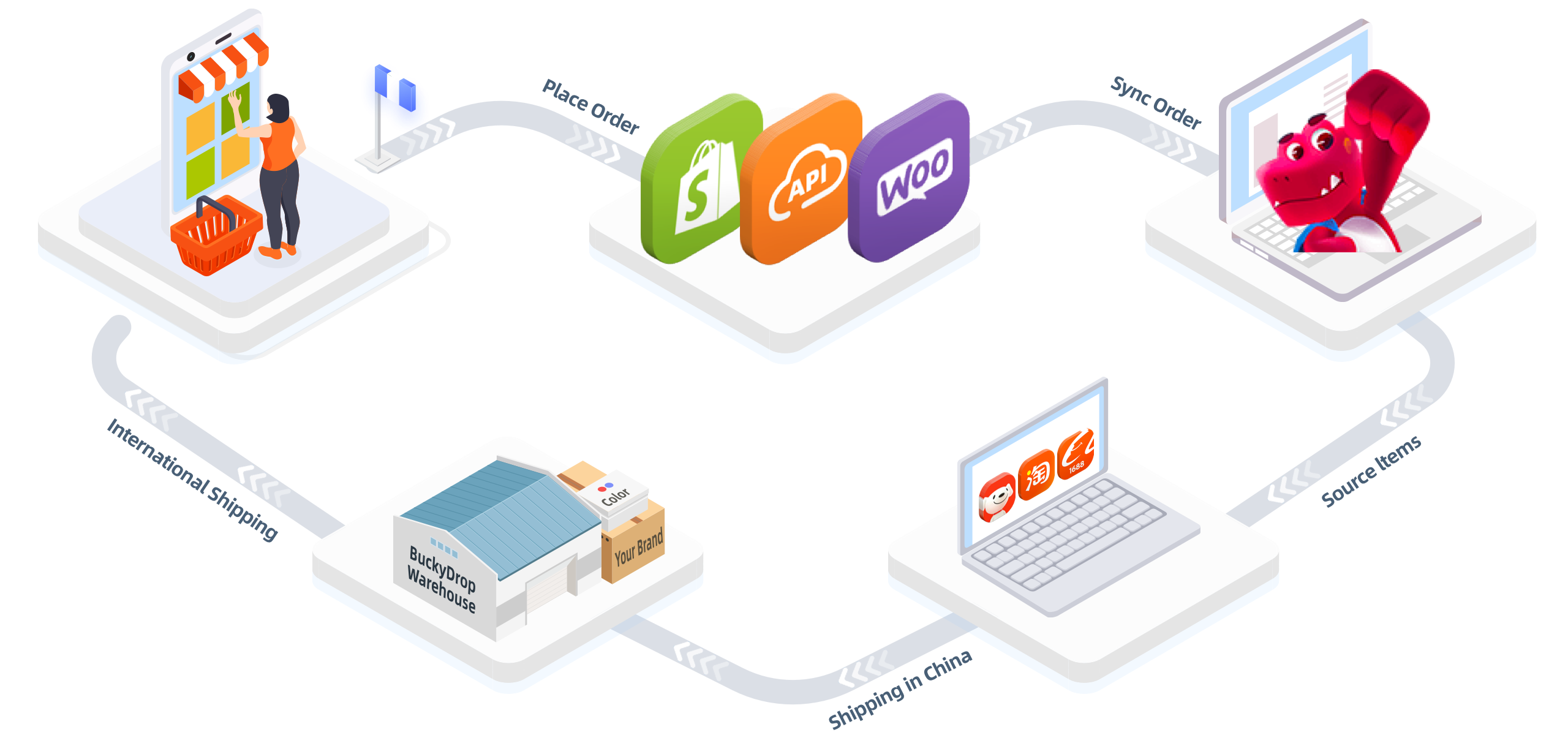
By this point, you’ve probably realised something. The issue isn’t finding suppliers—it’s making everything work together without constant manual effort. That’s where BuckyDrop fits in, not as another tool, but as a system that changes how your operations actually run.
One-Click Shopify Integration & Automated Workflow
Think about how orders usually work. A customer buys, you check it, forward it, confirm details, then wait. It works—until volume increases.
With BuckyDrop, Shopify connects directly into the system. Orders move straight into processing. That’s what automated order management looks like. Instead of handling everything manually, ecommerce order automation keeps things moving in the background—making it a far more scalable Shopify dropshipping platform setup.
Global Supply Chain with Vetted Suppliers
Supplier inconsistency is one of the biggest hidden risks. Products may look the same—but outcomes vary.
BuckyDrop works with vetted factories and standardises sourcing. It doesn’t remove all risk, but it reduces unpredictability—especially when order volume grows.
Local Warehouse Delivery (3–7 Days to the UK)
UK customers expect fast delivery. Waiting weeks is no longer acceptable.
With local warehouse support, shipping can be reduced to 3–7 days. That shift improves customer satisfaction and reduces complaints almost immediately.
Real-Time Inventory & Pricing Synchronisation
Stock issues often appear without warning. A product sells—but isn’t actually available.
Real-time syncing keeps inventory accurate, reducing overselling and cancellations. It’s a small detail that prevents bigger problems.
Compliance & Data Security (Shopify + GDPR Standards)
As your store grows, compliance becomes critical.
BuckyDrop aligns with Shopify standards and follows frameworks like GDPR, ensuring data and order processes meet established requirements.
Case Study — Scaling a Shopify Dropshipping Store with Automation
Let’s put this into a real scenario.
A Shopify seller starts out the usual way. Orders are handled manually. Suppliers are contacted one by one. At low volume, it works.
Then sales increase.
What used to take an hour now takes half a day. Mistakes start creeping in. Shipping times vary. Customer messages increase.
At that point, growth slows—not because demand drops, but because the system can’t keep up.
After switching to an automated setup with BuckyDrop, things change.
Orders move through the system without manual input. Fulfilment becomes consistent. Shipping times improve thanks to better coordination and local warehouse options. The workload drops significantly, even as order volume increases.
Within a few months, the business looks different.Not because the products changed.But because the process behind them did.
Dropshipping UK Checklist — How to Choose the Right Supplier or Platform
Before choosing any supplier or platform, it’s worth stepping back and asking a few simple questions.
● Does it support automated order fulfillment, or are you still expected to handle orders manually?
● Can it consistently deliver within 3–7 days to the UK?
● Are suppliers actually vetted, or is it an open marketplace model?
● Is inventory synced in real time, or will you be dealing with stock issues?
● Does it integrate directly with Shopify without extra steps?
● Can you see the full order process from placement to delivery?If the answer to most of these is unclear, that’s usually a warning sign.
Common Dropshipping Mistakes UK Sellers Should Avoid
Most mistakes don’t come from lack of effort. They come from focusing on the wrong priorities.
Choosing the cheapest supplier might look like a win at the start, but instability shows up later—delays, quality issues, and inconsistent stock.
Ignoring shipping expectations is another common issue. UK customers are used to fast delivery. If your timelines don’t match that, it affects everything from conversion rates to refunds.
Then there’s the reliance on manual processes. It works early on, but becomes a bottleneck as soon as orders increase, especially without proper dropshipping order management in place.
Quality control is often overlooked as well. Without consistency, returns become part of the business instead of an exception.
And finally, scaling ads too early. Driving more traffic into an unstable system doesn’t fix the problem—it amplifies it.
FAQ — Dropshipping UK (2026 Guide)
What is the best platform for dropshipping in the UK?
It depends on your setup, but most sellers use Shopify combined with a fulfilment system that supports automation and supplier management.
Is dropshipping from China safe?
Yes, but only if there is proper supplier vetting and fulfilment structure in place. Without that, quality and delivery can become inconsistent.
How fast is UK dropshipping delivery?
With local warehouse support, delivery can be as fast as 3–7 days. Without it, international shipping may take significantly longer.
What is automated order fulfillment?
It’s a system where orders move from your store into processing and shipping without manual handling, reducing delays and errors.
How do I reduce returns in dropshipping?
Focus on consistent product quality, accurate descriptions, and reliable shipping times. Most returns come from mismatched expectations.
What are the best dropshipping apps for Shopify?
The best apps are those that go beyond product sourcing and support full order automation and fulfilment integration.
Can I automate my Shopify dropshipping business?
Yes. With the right system in place, order processing, inventory updates, and fulfilment can all run automatically.
Is private label dropshipping worth it?
For long-term growth, yes. It allows you to build a brand instead of competing purely on price.
Do I need a local warehouse for UK dropshipping?
Not always, but it significantly improves delivery speed and customer satisfaction.
What is the biggest challenge in dropshipping today?
Not demand—but managing fulfilment, consistency, and scalability as order volume increases.
Final Thoughts
If there’s one clear shift in dropshipping UK right now, it’s this: success is no longer driven by products alone. It’s driven by systems.
You can still find a winning product. That hasn’t changed. But what happens after the sale—that’s where most businesses either stabilise or start to struggle. Orders increase, and suddenly the cracks appear. Manual processes slow things down. Suppliers become inconsistent. Delivery times stretch.
That’s why the focus in 2026 has moved toward three things: automation, supply chain control, and delivery speed.
Automation removes the repetitive workload. Instead of handling every order yourself, the process runs in the background. Supply chain control reduces uncertainty. You’re not guessing whether products will arrive as expected. And faster delivery aligns your store with what UK customers now expect.
So it’s worth asking—does your current setup support growth, or does it rely on you to hold everything together?
If you’re serious about scaling, the next step isn’t more products. It’s improving how your operation runs.
Platforms like BuckyDrop combine dropshipping services with automation, helping turn a fragmented process into a system that can actually keep up as your store grows.