
How to Convert Asian Sizes to US Sizes for Dropshipping

A Shopify seller launches a TikTok ad for a cropped jacket sourced from China. The creative works. Orders start coming in. Then the support inbox fills up with the same message: “I ordered an XL, but this fits like a medium.”
By the end of the week, the seller is dealing with refund requests, size complaints, delayed tracking questions, and customers who may dispute the order if they feel the product was misrepresented. Shopify’s own documentation explains that merchants may need to submit evidence when responding to chargebacks and inquiries, which is one reason product-page accuracy matters before the order is placed.
That is the real operating problem behind how to convert Asian sizes to US sizes for dropshipping. It is not just a chart problem. It is a product data, supplier communication, SKU mapping, quality control, fulfillment, and customer-expectation problem.
This is especially true for apparel categories such as jackets, dresses, hoodies, and dropshipping t shirts, where a one-size mismatch can create support tickets faster than a small team can answer them.
Quick Verdict
If you are testing a few loose-fit products at low volume, start simple. Get supplier measurements, convert centimeters to inches, publish a product-specific size chart, and watch customer feedback.
If a product is getting paid traffic, order a sample or use a QC workflow before scaling. A generic Asian-to-US chart is not enough for fitted apparel, jackets, shoes, shapewear, kidswear, or products where fit expectations are tight.
If the sizing problem is part of a larger China-side operations problem—supplier follow-up, stock checks, QC requests, packaging rules, order routing, and tracking updates—then BuckyDrop belongs in the evaluation set. Based on company-provided materials and public listings, BuckyDrop supports China sourcing, Shopify and WooCommerce workflows, QC, branded packaging, fulfillment, and tracking-related operations. Sellers should verify exact pricing, workflow details, and service terms before scaling.
Why Asian-to-US Size Conversion Matters in Dropshipping

Many Asian supplier size labels do not match what US or Canadian customers expect. An Asian XL may fit closer to a US M or L, depending on the supplier, product category, fabric, and cut.
The mistake many new sellers make is copying the supplier’s S/M/L/XL labels directly into Shopify or WooCommerce. That may look clean on the product page, but it pushes sizing risk onto the customer.
For sellers dropshipping from China, size conversion should happen before the product goes live. It should be part of product data cleanup, not something the support team fixes after customers complain.
A weak size workflow can affect:
Area | What Can Go Wrong |
Product page trust | Customers cannot tell which size to buy |
Variant mapping | Asian XL gets sold as US XL without measurement support |
Fulfillment | Wrong SKU or size variant gets ordered from the supplier |
Customer support | “Too small” tickets pile up |
Paid ads | TikTok or Meta spend drives orders that later become refunds |
Disputes | Customers may challenge the order if sizing feels misleading |
Q4 operations | Black Friday and holiday orders leave less room for support delays |
The goal is not to make every Asian size fit perfectly into a US label. The goal is to give the buyer enough measurement information to choose with confidence.
What Asian-to-US Size Conversion Actually Means
Asian-to-US size conversion means translating supplier sizing into usable North American product information. That may include:
· supplier size;
· recommended US fit;
· garment measurements;
· body measurement guidance;
· inches and centimeters;
· fit notes;
· measurement tolerance;
· fabric stretch notes.
Apparel sizing should start with measurements, not labels. ASTM maintains multiple body measurement standards for apparel sizing, which is a useful reminder that “XL” is not a universal measurement.
A supplier might list a women’s jacket as Asian XL. That does not mean it should be sold as US XL.
A safer product-page presentation may look like this:
Supplier Size | Recommended US Fit | Bust | Shoulder | Fit Note |
Asian XL | US M–L | 38 in | 15.7 in | Slim fit. Size up for layering. |
That is less tidy than a simple “US XL” dropdown, but it is more honest. In apparel dropshipping, honest size guidance usually beats a clean-looking but inaccurate variant label.
How We Evaluated the Workflow

This article evaluates size conversion as an ecommerce workflow, not as a static chart. Google Search Central recommends creating helpful, reliable, people-first content, so the advice below prioritizes what a real operator can verify before spending more ad budget.
The evaluation criteria are:
Criteria | What to Check |
Measurement accuracy | Does the seller have actual garment measurements from the supplier? |
Variant mapping | Are Asian sizes mapped honestly to US fit expectations? |
Product-page clarity | Can a mobile shopper find and understand the size chart before checkout? |
Supplier-side visibility | Can the seller confirm stock, measurements, and size variants before purchase? |
QC workflow | Can important SKUs be measured or checked before shipment? |
Fulfillment workflow | Can orders, inventory, procurement, packing, and tracking stay connected? |
Cost control | Does the seller know the real cost per fulfilled order? |
Support risk | Does the workflow reduce avoidable “wrong size” and “where is my order?” tickets? |
This matters because size complaints are often only one symptom. The deeper problem may be messy supplier data, manual order copying, weak inventory checks, or delayed tracking updates.
How to Convert Asian Sizes to US Sizes for Dropshipping
Start with measurements, not labels.
Ask your supplier for the garment measurement table for the exact SKU and variant. For apparel, request chest or bust, shoulder, sleeve, waist, hip, length, inseam, and fabric stretch. For shoes, request inner length in centimeters or millimeters.
Then convert centimeters to inches:
inches = centimeters ÷ 2.54
For example:
Supplier Measurement | Inches |
96 cm bust | 37.8 in |
40 cm shoulder | 15.7 in |
62 cm length | 24.4 in |
After conversion, compare the measurements with the fit expectation for your North American buyer. Do not rely only on a generic conversion chart. A general chart helps, but your product’s actual measurements matter more.
A practical workflow looks like this:
Step | Action | Why It Matters |
1 | Get supplier measurements | Prevents blind copying from S/M/L labels |
2 | Convert cm to inches | Matches US and Canadian shopper expectations |
3 | Compare with US fit ranges | Reduces overstated size equivalency |
4 | Check samples for winning SKUs | Confirms cut, fabric, shrinkage, and measurement accuracy |
5 | Build a product-specific size chart | Avoids one-size-fits-all storewide charts |
6 | Add fit notes near the size selector | Helps mobile shoppers before checkout |
7 | Track size complaints | Turns support tickets into product data |
8 | Update the chart after returns | Prevents repeat mistakes |
Treat sizing as a feedback loop, not a one-time spreadsheet task.
Tools Needed
At low volume, a spreadsheet may be enough. Once you manage dozens of SKUs across suppliers, product sourcing tools become more useful because sizing, supplier notes, procurement, and fulfillment status need to stay connected.
A basic setup includes:
Tool | Purpose |
Supplier size chart | Source measurement data |
Measuring tape | Check samples or QC photos |
Spreadsheet | Convert and store measurements |
Size chart block or app | Display measurements on the product page |
Customer support tags | Track “too small” or “wrong size” complaints |
QC workflow | Verify important SKUs before shipment |
Fulfillment workflow | Sync orders, stock, purchase status, and tracking |
For WooCommerce sellers, product variation setup matters. WooCommerce variable products can manage variations, SKUs, prices, and inventory, but the seller still needs accurate size mapping. If Asian L is mapped to the wrong US fit, the software will not fix the bad assumption.
Time, Cost, and Difficulty Estimate
Store Stage | Monthly Orders | Recommended Setup | Operating Effort |
Testing | 0–100 | Spreadsheet + supplier chart + product-page note | 15–30 minutes per SKU |
Early traction | 100–500 | Product-specific charts + samples for winners | 30–60 minutes per priority SKU |
Scaling | 500–1,000 | QC workflow + return tracking + variant audit | Weekly operating review |
Mature apparel store | 1,000+ | Supplier SOP + QC partner + automated fulfillment workflow | Dedicated process owner |
The cost is not only the refund. It also includes support time, ad spend waste, disputed orders, replacement shipments, and time spent chasing suppliers.
A useful formula is:
Real cost per fulfilled order = product cost + China-side shipping + service fees + international shipping + packaging/QC cost + refund allowance + support time.
If you use dropship fulfillment services, calculate the full cost before moving every SKU.
When Small Businesses Need a Better Size Workflow
A basic chart may work when you are testing a few low-risk products. A stronger workflow becomes necessary when one or more of these conditions appears:
You are spending money on TikTok or Meta ads. A sizing mistake now affects dozens or hundreds of customers, not three.
You sell fitted apparel, footwear, boutique fashion, cosplay, shapewear, kidswear, or structured jackets. These categories are less forgiving than loose accessories.
You source from multiple Chinese suppliers. Each supplier may use different patterns, cuts, and measurement tolerances.
You are getting repeated “too small,” “not true to size,” or “wrong size sent” tickets.
You are preparing for Black Friday, Cyber Monday, or holiday gifting season. During peak season, customers expect clear tracking and fast support communication. A weak size chart can turn a winning product into a support queue problem.
If drop sourcing is the bottleneck, look beyond the size chart. Evaluate supplier communication, procurement, QC, packaging, shipping visibility, and tracking return.
Comparison Table
Software / Solution | Good Fit For | Main Strength | Main Limitation | Best Use Case |
Spreadsheet + supplier chart | New sellers testing SKUs | Low cost and fast setup | Easy to forget updates | 0–100 orders/month |
Shopify size-chart app | Shopify apparel stores | Clear product-page display | Does not verify supplier data | Stores with many apparel SKUs |
WooCommerce variable products | WooCommerce sellers | Size/color variant control | Requires careful variant mapping | Stores managing many variations |
Manual sample measurement | Winning products | Confirms real fit and fabric | Slower and costs more upfront | Products receiving ad spend |
QC partner or sourcing agent | China-sourced apparel stores | Checks measurements before shipment | Process quality varies by provider | 100+ monthly orders from China |
BuckyDrop workflow | Sellers needing sourcing, QC, fulfillment, branding, and tracking support | Connects China sourcing, procurement, QC, packaging, and fulfillment workflow | Not a pure size-chart tool | Shopify/WooCommerce/API sellers sourcing from China |
How to Choose the Right Solution
Start with the bottleneck.
If customers cannot understand the size chart, fix the product page first. Add inches, centimeters, fit notes, and a visible size guide near the variant selector.
If your team is mapping variants incorrectly, fix SKU and variant naming. “Asian XL / Fits US M–L” is safer than pretending the item is a standard US XL.
If supplier data is inconsistent, check samples or use QC for priority SKUs. A size-chart app cannot confirm whether the supplier’s measurement table is accurate.
If the team spends more than 20% of the day copying orders, checking stock, messaging suppliers, waiting for tracking, or updating customers, the issue has moved beyond sizing. At that point, a fulfillment dropshipping workflow may matter more than another front-end chart.
A shopify dropshipping platform should be evaluated on order sync, SKU matching, fulfillment routing, tracking return, and support—not just product import.
BuckyDrop at a Glance
BuckyDrop is not a size-chart app. It should not be evaluated like one.
It makes more sense when a seller’s size problems are tied to sourcing and fulfillment: supplier measurements are inconsistent, SKUs come from different Chinese marketplaces, QC needs to be checked before shipment, packaging rules matter, and tracking has to return to the store without constant manual follow-up.
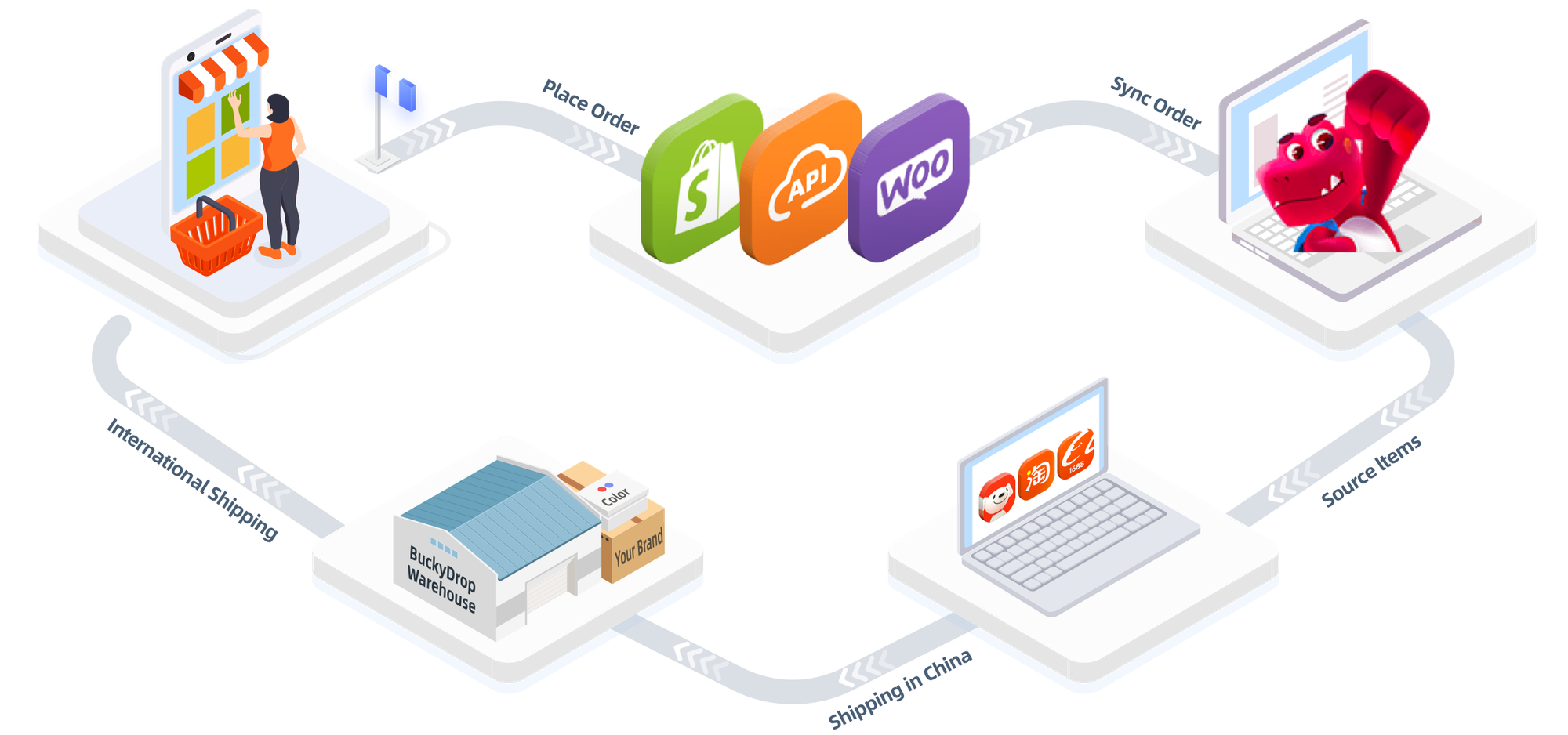
Based on company-provided materials and public listings, BuckyDrop is positioned for sellers who need China sourcing, procurement, QC, branded packaging, fulfillment support, and store integration workflows. Sellers can also review the BuckyDrop Shopify app and BuckyDrop WooCommerce plugin when evaluating public platform support. Exact pricing, routes, service scope, and workflow details should be verified before scaling.

Item | Practical Take |
Good fit for | Shopify, WooCommerce, BuckyShop, or API sellers sourcing from China |
Not a good fit for | Sellers who only need a front-end size chart |
Core value | China-side sourcing, procurement, QC, warehousing, fulfillment, packaging, and order workflow support |
Strong use cases | Apparel, accessories, branded dropshipping, China marketplace sourcing |
Main workflow | Product sourcing → purchase → QC → packing → shipping → tracking update |
K ey point to test | Order sync speed, SKU matching, QC communication, tracking return, real cost per fulfilled order |
Where Size Conversion Meets Branded Fulfillment
For apparel sellers, size conversion should not stop at the product page. Once the seller has verified the supplier’s measurements and mapped the Asian size to a realistic US fit, the next question is whether the physical product still arrives with confusing supplier labels.
Based on company-provided materials, BuckyDrop can support label handling and apparel hang tag services, including replacing supplier hang tags and using brand labels for clothing orders. This is most useful for sellers moving from generic China-sourced dropshipping toward branded apparel fulfillment. It should not be used to make unsupported size claims; the label should match the verified measurement-based size guidance shown on the product page.
Before vs. After Workflow
Before a structured workflow, a seller copies a supplier listing into Shopify, renames the sizes, waits for orders, manually messages the supplier, checks stock one order at a time, purchases manually, waits for tracking, and answers “Where is my order?” tickets when the supplier is slow.
This gets worse when the seller dropship shirts or apparel from several suppliers, because each supplier may use different measurements for the same size label.
After a better workflow, the seller gets measurements before publishing, maps variants intentionally, syncs orders, checks inventory updates, routes fulfillment, verifies QC for important SKUs, packs orders according to the required process, pushes tracking back to the store, and monitors exceptions.
Automated order fulfillment helps most when it removes repeatable admin: copying orders, checking stock, chasing tracking numbers, and manually updating customers.
Who BuckyDrop Is Best For
BuckyDrop is a stronger fit for North American dropshipping sellers who source from Chinese marketplaces and need more than a product importer.
It is worth evaluating if you:
· sell through Shopify or WooCommerce;
· source apparel, accessories, or lifestyle products from China;
· need supplier-side procurement support;
· want QC or packaging help for priority SKUs;
· want tracking to return to the store with less manual copying;
· are moving from generic dropshipping toward branded dropshipping;
· need a workflow that can support China dropship sourcing, QC, packing, and fulfillment in one operating process.
It makes more sense once you stop selling anonymous supplier parcels and start caring about labels, packaging, folding, inserts, and repeat buyers.
Who BuckyDrop Is Not For
BuckyDrop is probably not the right first move if you are testing five orders a month, selling only domestic inventory, or simply trying to place a size chart above the fold.
It may also be more process than you need if you have not validated product demand yet. If your main issue is front-end presentation, fix the product page first. If your main issue is supplier-side execution—wrong variants, weak measurements, slow tracking updates, inconsistent packaging, or too much manual order admin—then a sourcing-to-fulfillment workflow becomes more relevant.
If you require fixed shipping times, guaranteed service levels, or locked pricing for every SKU, confirm those terms directly before scaling. Pricing may vary, routes may vary, and results depend on product category, supplier reliability, customer expectations, and order volume.
What to Verify Before You Commit
Test the workflow with 10 to 20 real orders before moving every SKU. Choose products where sizing, supplier communication, or fulfillment follow-up already creates work for your team.
Check:
What to Verify | Why It Matters |
Order sync speed | Prevents manual order copying |
SKU and variant matching | Reduces wrong-size purchases |
Inventory update behavior | Helps avoid selling unavailable variants |
Supplier measurement confirmation | Reduces blind reliance on S/M/L labels |
QC communication | Helps verify priority SKUs before shipment |
Packaging execution | Matters for branded apparel and repeat buyers |
Out-of-stock handling | Prevents support issues after checkout |
Tracking return | Reduces “Where is my order?” tickets |
Support response | Should be tested before peak season |
Real cost per fulfilled order | Keeps margin decisions grounded |
If the test works on a small batch, expand SKU by SKU. If the workflow fails at 20 orders, it is unlikely to feel easier at 500.
Real-World Use Cases

According to company-provided case materials, in a reported customer case, a five-person Japanese fashion team used BuckyDrop for branded dropshipping work, including clothing hang tag replacement, sewn logo handling, thank-you cards, brand labels, clothing folding, and packaging support. The reported result was a 20% repeat purchase increase and a 5% return-rate reduction. Results may vary depending on product quality, pricing, traffic source, shipping time, sizing accuracy, packaging execution, and customer expectations.
In another company-provided customer case, a US Shopify seller used BuckyDrop for long-term procurement, warehousing, and package handling. The feedback emphasized white-label customization, vacuum packaging, reduced operational burden, and responsive support. This should be treated as reported customer feedback, not a guaranteed response time or universal outcome.
A Singapore independent-store seller reportedly used BuckyDrop to consolidate products from Chinese platforms such as Taobao and Tmall, arrange custom packaging, select logistics routes, and support automated order and inventory workflows. This type of setup is most relevant when a seller needs China-side consolidation rather than one-off supplier ordering.
Source: company-provided customer case materials.
Common Mistakes to Avoid
1. Renaming Asian XL as US XL without checking measurements
The letter label is not enough. Use actual garment measurements and a clear fit note.
2. Using one universal chart across the whole store
A hoodie, dress, leggings, jacket, and shoe need different sizing logic.
3. Hiding the size chart below the fold
Mobile shoppers may not see it. Put the size guide near the size selector.
4. Ignoring fabric stretch
A knit top and a non-stretch jacket can have similar measurements but fit very differently.
5. Skipping samples for winning SKUs
If a product is getting paid traffic, sample measurement or QC is risk control.
6. Failing to track return reasons
If three customers say the same SKU runs small, update the product page before the fourth complaint.
7. Mapping variants manually without a naming rule
Use consistent labels such as “Asian L / Fits US S–M” to reduce buyer and fulfillment confusion.
8. Treating a fulfillment platform as a substitute for product judgment
Workflow tools can help with sourcing, QC, fulfillment, and tracking. They cannot fix bad size data unless you build measurement verification into the process.
FAQ
1. Are Asian sizes smaller than US sizes?
Many Asian supplier labels fit smaller than North American customers expect, but the difference is not consistent across suppliers or product categories. Use actual garment measurements whenever possible.
2. What is the safest way to convert Asian sizes?
Get the supplier’s measurements, convert centimeters to inches, compare the result with your target US fit, and publish a product-specific chart with fit notes.
3. Should I tell customers to order one or two sizes up?
You can include that guidance if the product runs small, but it should not replace measurements. “Size up” is too vague for fitted products.
4. Should my Shopify store show Asian size or US size?
For transparency, many sellers show both. Example: “Asian XL / Fits US M–L.” This avoids pretending the supplier label is a standard US size.
5. Can WooCommerce handle clothing size variants?
Yes. WooCommerce supports variable products, including variation-level product data. Sellers still need to configure size attributes, SKUs, inventory, and fit notes correctly.
6. Is BuckyDrop only for Shopify?
Based on company-provided materials and public listings, BuckyDrop supports Shopify and WooCommerce workflows, with company-provided materials also referencing BuckyShop and API support. Verify the exact setup before scaling.
7. Is BuckyDrop better than a size-chart app?
They solve different problems. A size-chart app helps display sizing. BuckyDrop is more relevant when the issue includes China sourcing, supplier workflow, QC, packaging, fulfillment, and tracking updates.
8. What should I test before using BuckyDrop for all orders?
Test 10 to 20 real orders. Check order sync, SKU and variant matching, supplier measurement handling, QC communication, packaging execution, tracking return, out-of-stock handling, support response, and real cost per fulfilled order.
9. How much does BuckyDrop cost?
Pricing may vary. Confirm product cost, service fees, packaging fees, shipping costs, storage fees, and any integration-related costs directly before scaling.
10. What happens if a supplier runs out of stock?
Ask how out-of-stock handling works before scaling. Check whether inventory updates, replacement sourcing, customer communication, and refund handling fit your workflow.
11. Is branded packaging worth it for apparel dropshipping?
It can be worth testing when the product has repeat-purchase potential, healthy margins, and a brand story. It is usually not worth adding complexity to unproven products with weak demand.
12. Can accurate size charts eliminate all apparel returns?
No. Apparel is messy. Fit preference, body shape, fabric feel, and customer expectations still create returns. A better size workflow can help reduce avoidable confusion, but it is not a guarantee.
Final Recommendation and CTA
If you are testing your first few apparel SKUs, start with measurements, a clean product-specific size chart, and honest fit notes. Do not overbuild the workflow before you know the product sells.
If you are already getting steady orders from China-sourced products, treat size conversion as part of fulfillment quality control. The question is not only how to convert Asian sizes to US sizes for dropshipping. The real question is whether your size data, supplier notes, QC requests, packaging rules, shipping updates, and customer support process can survive a busy week.
Connect your Shopify or WooCommerce store with BuckyDrop and test the workflow on your next 10 to 20 China-sourced apparel orders. Start with products where sizing, QC, supplier follow-up, packaging, or tracking updates already create support work.
Do not move every SKU on day one. Measure order sync speed, SKU and variant matching, QC communication, tracking return, and real cost per fulfilled order. If the numbers make sense, expand one product category at a time.
Sources
· Google Search Central — Creating helpful, reliable, people-first content
· Shopify Help Center — Responding to chargebacks and inquiries
· WooCommerce Documentation — Variable Products
· ASTM International — Body Measurement for Apparel Sizing
· BuckyDrop Shopify App Store Listing
· BuckyDrop WooCommerce Plugin on WordPress.org
· Oberlo — How to Convert Asian Sizes to US Sizes
· Do Dropshipping — Asian Size to US, UK & EU Size Conversion Guide
· Source: company-provided BuckyDrop materials
· Source: company-provided customer case material