What Is Ghost Commerce? How It Works and How to Fulfill Orders Without Holding Inventory

What Is Ghost Commerce?
Ghost commerce is a broad term for an ecommerce business that operates a customer-facing store without managing most of the physical supply chain in-house.
The merchant usually controls:
· The online storefront
· Product positioning and pricing
· Marketing and advertising
· Customer data
· Customer support
· Refund and replacement decisions
A supplier, print-on-demand company, sourcing agent, warehouse, or fulfillment provider may handle:
· Product manufacturing or procurement
· Inventory storage
· Warehouse receiving
· Product inspection
· Package processing
· International shipping
· Tracking updates
In this article, ghost commerce is used as an informal operating term rather than a specific platform, tax, or legal category.
The “ghost” part does not mean the products or business are imaginary. It means much of the infrastructure behind the store is outsourced and usually invisible to the customer.
What Ghost Commerce Is Not
Ghost commerce is not automatically passive income.
A supplier may ship the parcel, but the customer still purchased from your store. If the wrong size arrives, the tracking stops updating, or the product does not match the description, the customer contacts you—not the factory or warehouse.
It is also different from affiliate marketing. An affiliate normally sends traffic to another merchant and earns a commission. A ghost commerce operator often controls checkout, sets the retail price, collects payment, and remains responsible for the customer experience.
How Does Ghost Commerce Work?

A typical physical-product order moves through the following workflow:
1. The merchant selects a target market and product.
2. The product is listed on Shopify, WooCommerce, or another storefront.
3. Traffic comes from SEO, email, creators, TikTok, Meta, Google Ads, or other channels.
4. A customer places and pays for an order.
5. The order is sent to a supplier or fulfillment provider.
6. The product is manufactured, purchased, or allocated from supplier inventory.
7. The item is inspected or processed according to the selected service.
8. The parcel is packed and handed to a carrier.
9. Tracking information returns to the store.
10. The merchant manages delivery questions, refunds, disputes, and replacements.
Shopify defines fulfillment as the workflow of processing, managing, and shipping customer orders. Merchants can fulfill orders themselves or use third-party apps and fulfillment services through Shopify’s order fulfillment workflow.
The storefront is rarely the weakest point. Most failures happen after checkout: the wrong variant is purchased, supplier stock changes without warning, a package does not receive a useful carrier scan, or tracking never reaches the customer.
Accurate inventory information matters because an active supplier listing does not guarantee that the exact source SKU remains available. Shopify’s inventory management documentation identifies avoiding sales of unavailable products as a core inventory-management function.
As order volume and supplier count grow, dropshipping order management becomes less about viewing orders and more about controlling stock exceptions, variant mismatches, supplier changes, and tracking gaps.
Four Ways to Fulfill Orders Without Holding Inventory
1. Supplier-Direct Fulfillment
The supplier receives the order and ships the product directly to the customer.
This may work when a store is testing one or two straightforward products from a reliable supplier. It becomes harder when the merchant adds multiple suppliers, complex variants, bundles, or branded packaging.
Before increasing ad spend, verify:
· How stock changes are communicated
· How variants are identified
· Whether substitutions require approval
· Which carrier and route will be used
· Whether supplier advertising appears inside the parcel
· Who handles damaged or incorrect products
2. Print-on-Demand

The product is manufactured after the customer orders. Common examples include printed apparel, wall art, mugs, and personalized accessories.
Print-on-demand can reduce finished-goods inventory exposure, but sellers still need to test print consistency, production time, packaging, replacement policies, and margin after shipping.
3. Sourcing Agent and Centralized Fulfillment
A sourcing or fulfillment partner purchases goods from one or more suppliers, receives them at a warehouse, checks them, consolidates products when needed, and ships the final parcel.
This adds another operational layer, but it can provide more control than asking unrelated suppliers to ship directly to the same customer.
Merchants comparing dropshipping fulfillment services should look beyond order forwarding and ask who manages sourcing, warehouse receipt, inspection, packing, tracking return, and fulfillment exceptions.
4. Automated Fulfillment Platform
An automated workflow connects the storefront with the sourcing or fulfillment system. Depending on the provider and integration, it may synchronize:
· Store orders
· Product and supplier mappings
· Inventory or price changes
· Purchasing status
· Fulfillment status
· Tracking information
Tracking can return automatically when the fulfillment provider, carrier, integration, and order configuration support it. Shopify explains that tracking supplied by an integrated third-party service can be added to the order automatically; otherwise, merchants may need to add or correct it manually. See Shopify order tracking.
Automation should be applied to a tested workflow. Connecting an unreliable supplier does not make that supplier reliable. It simply moves problematic orders through the system faster.
Ghost Commerce vs. Dropshipping
Dropshipping and ghost commerce overlap, but they are not exact synonyms.
Area | Ghost Commerce | Traditional Dropshipping |
Main concept | A broader outsourced ecommerce structure | A specific fulfillment method |
Inventory | Usually held by a third party or produced after purchase | Usually held by the supplier |
Fulfillment options | Supplier direct, POD, sourcing agent, warehouse, or platform | Usually supplier-to-customer shipping |
Branding potential | Can range from generic shipping to branded packaging | Often limited in basic setups |
Merchant responsibility | Store, marketing, support, refunds, and supplier coordination | Store, marketing, support, refunds, and supplier coordination |
Operational complexity | Depends on the backend model | Often simple at launch but harder with more suppliers |
Dropshipping can be the fulfillment method inside a ghost commerce business.
However, a store using centralized sourcing, detailed inspection instructions, custom packaging, and coordinated international shipping operates differently from a basic supplier-direct store.
A Practical Shopify or WooCommerce Workflow
Consider a U.S. seller testing home-organization products from several Chinese suppliers.
This is an example scenario, not a reported customer result.
The seller orders samples and approves two products. Each Shopify variant is mapped to a specific supplier SKU. The seller publishes accurate dimensions, product photos, processing expectations, and refund terms.
When a customer orders:
1. The order enters Shopify.
2. The product and variant are matched to the approved source.
3. The item is purchased from the supplier.
4. The warehouse receives and checks it.
5. The item is packed according to the merchant’s instructions.
6. A shipping route is selected.
7. Tracking returns to Shopify.
8. The customer receives shipment updates.
9. Exceptions are reviewed by the seller or fulfillment team.
At a few orders per week, the seller may still manage parts of the process manually. Once daily orders, supplier count, SKU complexity, and exception rates increase, the same manual process can create delayed purchasing, incorrect variants, and a growing support queue.
A North American test should include more than one destination. Send test orders to at least one U.S. address and one Canadian address. Record the time from customer payment to supplier purchase, warehouse receipt, dispatch, first carrier scan, and final delivery.
Do not assume that a successful U.S. route will produce the same result in Canada. Carrier handoffs, customs processing, remote-area delivery, and customer expectations may differ.
Before Black Friday and Cyber Monday, repeat the test under current carrier conditions rather than relying on results from a quieter month. Do not promise tracking within a specific period unless your own route data consistently supports that claim.
Benefits, Costs, and Operational Trade-Offs

The main financial benefit is reduced exposure to unsold inventory. A merchant can test customer demand before committing to a large wholesale order.
The trade-off is reduced direct control.
The merchant cannot personally inspect every unit or see every supplier-side delay. Systems, service standards, and exception rules must replace that missing visibility.
Ghost commerce may be suitable when you:
· Have stronger marketing skills than warehousing capabilities
· Want to test demand before buying inventory
· Can manage customer support and refunds
· Are prepared to order samples
· Can tolerate cross-border fulfillment lead times
· Are willing to monitor suppliers and routes
It may be a poor fit when you:
· Require same-day domestic dispatch
· Sell highly regulated, perishable, or safety-sensitive products
· Need exact batch consistency
· Refuse to test samples
· Expect the business to run without customer support
· Cannot absorb refund, replacement, or advertising losses
What Does Ghost Commerce Actually Cost?
“No inventory” does not mean “no cost.”
A useful contribution-margin calculation is:
Selling price − product cost − fulfillment fees − shipping − payment fees − acquisition cost − refund and replacement allowance
Additional costs may include:
· Ecommerce platform and application fees
· Product samples
· Quality inspection
· Custom packaging
· Duties or taxes where applicable
· Currency conversion
· Customer support
· PayPal disputes
· Shopify chargebacks
Shopify lists “product not received” and “product unacceptable” as chargeback categories. Tracking records may help respond to non-delivery disputes, while accurate product descriptions and evidence of replacements may matter when a customer claims the product was damaged or not as described. See Shopify’s chargeback guidance.
For U.S. customers, shipping promises also need to be supportable. The FTC states that sellers generally must ship within the advertised period, or within 30 days if no period is stated. If shipment is delayed, the customer must be notified and given the choice to accept the delay or cancel for a refund. See the FTC’s online order guidance. This is general operational information, not legal advice.
How to Start a Ghost Commerce Business
Step 1: Choose a Specific Customer Problem
Start with a customer and use case, not a random list of viral products.
A specific problem makes it easier to assess product quality, write the product page, create ads, and decide whether the final delivered price makes sense.
Step 2: Screen Products for Fulfillment Risk
Review:
· Product dimensions and weight
· Fragility
· Batteries, liquids, or shipping restrictions
· Size and color complexity
· Compatibility claims
· Return likelihood
· Product-specific compliance requirements
· Packaging needs
Products with many similar variants create more mapping risk.
Step 3: Order Samples
Test the product, packaging, delivery notifications, and actual customer experience.
A sample cannot guarantee future batch consistency, but it gives you a baseline for materials, dimensions, packaging, and shipping performance.
Step 4: Select the Store and Fulfillment Structure
Shopify and WooCommerce can both support outsourced fulfillment, but the right choice depends on hosting responsibility, technical resources, app availability, and the integration you plan to use.
Compare those factors before choosing between different dropshipping platforms.
Step 5: Define the Source for Every Variant
Map every store variant to an approved supplier SKU.
Do not depend only on labels such as “blue medium.” Record the supplier link, source SKU, expected specifications, approved photos, and substitution rules.
Step 6: Publish Accurate Store Policies
Your store should clearly explain:
· Product specifications
· Processing expectations
· Estimated delivery windows
· Returns and refunds
· Contact information
· Tracking access
· Damaged or incorrect item procedures
Do not promise domestic-style delivery when the product is being sourced internationally after purchase.
Step 7: Define Who Owns Each Fulfillment Step
Assign responsibility for:
· Supplier confirmation
· Purchasing
· Warehouse receiving
· Inspection
· Packaging
· Shipping selection
· Tracking upload
· Lost-package follow-up
· Replacement approval
· Customer communication
When ownership is unclear, the problem eventually becomes a customer-support ticket.
Step 8: Run a Controlled 10-to-20-Order Test
A practical starting point is to test the workflow with 10 to 20 real orders. This is an editorial recommendation, not an industry standard or guarantee.
Measure:
· Order sync speed
· Procurement time
· Variant accuracy
· Inspection exceptions
· Tracking return
· Time to first carrier scan
· Delivery performance
· Customer-support workload
· Cost per fulfilled order
Keep TikTok, Meta, and Google ad spend controlled until the backend performs consistently.
Step 9: Review Exceptions

Do not review only successfully delivered orders.
Document:
· Out-of-stock products
· Supplier price changes
· Incorrect variants
· Failed inspections
· Lost packages
· Tracking gaps
· Refunds
· Replacements
· Customer complaints
A workable system should surface these exceptions early enough for someone to make a decision before the customer complains.
Manual vs. Automated Fulfillment
Business Situation | Manual Workflow | Automated Workflow |
Testing one to three products | Often sufficient | Optional |
A few weekly orders | Usually manageable | May add unnecessary setup |
Multiple suppliers | Difficult to coordinate | More useful |
Frequent stock changes | Higher overselling risk | Inventory updates may help |
Many variants | Higher mapping risk | Useful after mappings are verified |
Growing daily volume | Creates repetitive work | Can reduce manual processing |
Multiple stores | Harder to coordinate | Easier to centralize |
Once the manual process has been tested, automated order fulfillment can help reduce repetitive order submission and tracking updates, provided product mappings and exception rules are stable.
When a fulfillment service integrates with Shopify through an app, merchants may be able to request fulfillment, monitor progress, cancel requests, and receive status updates inside Shopify. The exact workflow depends on the app and provider. See Shopify’s documentation on app-based fulfillment services.
Before vs. After a Centralized Workflow
Before | After |
Copy orders to suppliers manually | Orders enter a centralized queue |
Ask each supplier about stock | Stock exceptions may surface earlier |
Paste tracking numbers manually | Tracking may return through the integration |
Coordinate suppliers separately | Purchasing and fulfillment are managed in one workflow |
Discover problems from customer emails | Exceptions can be reviewed before shipment |
Automation is justified when manual work creates missed orders, variant errors, delayed purchasing, or tracking gaps—not because automation looks more professional.
What to Verify Before You Commit
Do not approve a fulfillment provider based only on a clean standard-order demonstration.
Ask the provider to show how the workflow handles:
1. An out-of-stock supplier SKU
2. A supplier price increase
3. An incorrect variant
4. A failed inspection
5. A split shipment
6. A parcel with no useful carrier scan
7. A customer cancellation after purchasing begins
8. A lost or damaged package
Confirm:
· Which sourcing platforms are supported
· How SKU and variant mappings are maintained
· Which inspections are included
· Which inspections require an additional service
· Whether inspection photos are available
· How substitutions are approved
· How tracking returns to the store
· What account funding is required
· How package-processing fees are calculated
· Whether custom packaging has minimum requirements
· Which routes are available for the U.S. and Canada
· Who handles each fulfillment exception
Run these checks with one to three products before connecting a large catalog.
Where BuckyDrop Fits in a Ghost Commerce Workflow
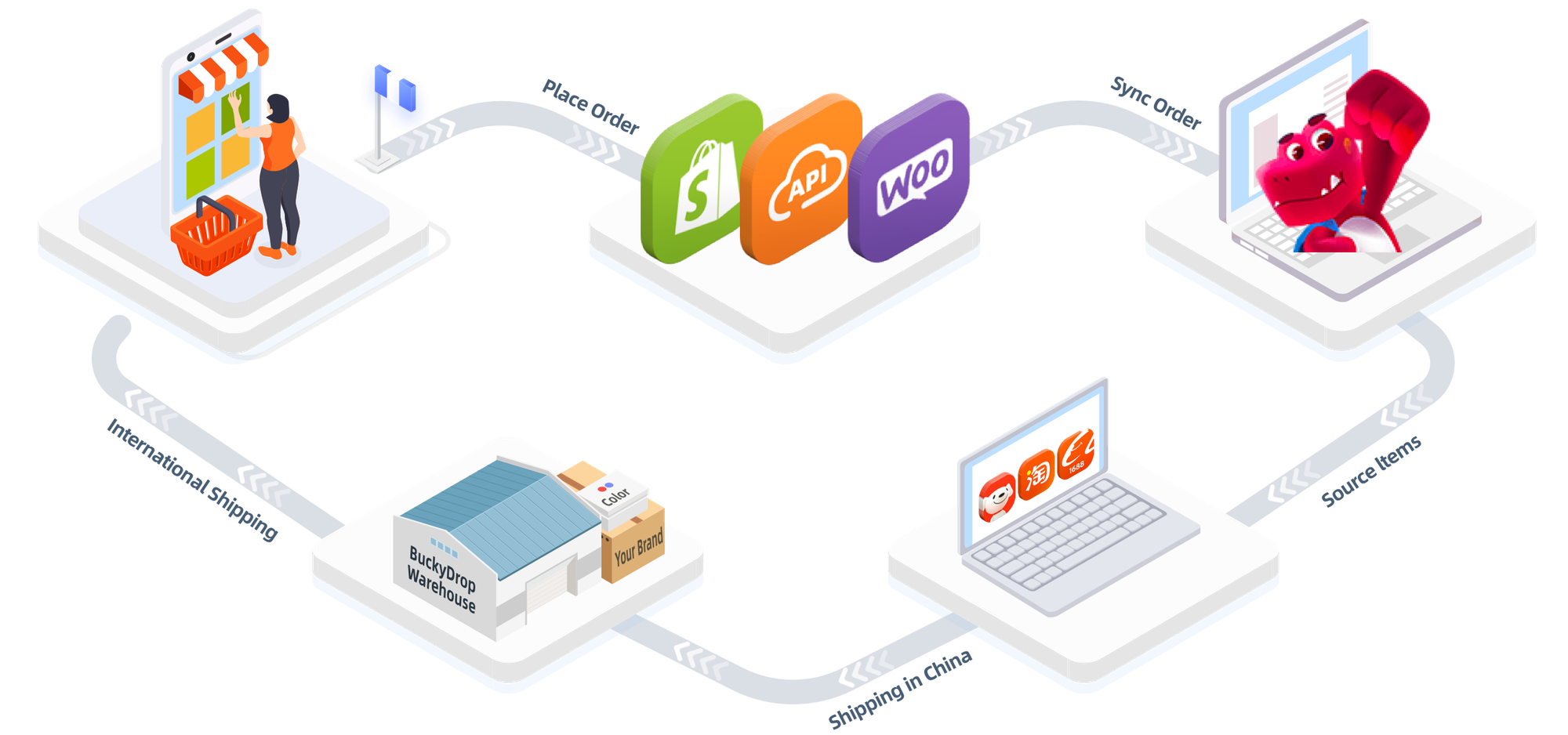
BuckyDrop becomes relevant when the problem is no longer finding a product but coordinating the work behind each order.
A seller using several Chinese suppliers may need one place to manage purchasing, warehouse receipt, inspection instructions, package processing, international shipping, and order-status updates.
Based on its public materials, BuckyDrop provides dropshipping services for merchants sourcing products from Chinese ecommerce marketplaces. Its fulfillment workflow describes Shopify and WooCommerce order synchronization, sourcing, warehouse receiving, quality checks, package processing, international shipping, and tracking updates. These are provider-stated capabilities, not a guarantee that every supplier, SKU, carrier, or destination will perform the same way.
Its services page distinguishes between a rough quantity and condition check when newly purchased goods arrive and a more thorough inspection when an inspection service is requested. Merchants should confirm the inspection scope, cost, evidence provided, and product-specific limitations before scaling.
The public BuckyDrop Shopify App Store listing, reviewed on July 30, 2026, describes China sourcing, product customization, stock and price updates, order fulfillment, and tracking features. A BuckyDrop plugin listing on WordPress.org also confirms the availability of a WooCommerce plugin. Features, compatibility, pricing, usage limits, and external charges may change and should be verified before implementation.
BuckyDrop may be worth evaluating when you:
· Source from multiple Chinese suppliers
· Need products received before international shipment
· Want inspection or package-processing options
· Operate a Shopify or WooCommerce store
· Need purchasing and tracking tied to a store workflow
· Plan to move from generic fulfillment toward branded packaging
It may add less value when:
· Your stock is already held by a reliable domestic warehouse
· Your manufacturer fulfills orders directly
· You need same-day North American dispatch
· You have not yet selected or sampled a product
· Your order volume and supplier count are still very low
No platform removes supplier-side changes, carrier delays, or customer-service responsibility. Test the actual setup with your products, sources, routes, and store configuration.
Common Ghost Commerce Mistakes
Launching Without Samples
Product photos do not confirm materials, dimensions, packaging, or shipping performance.
Treating the Supplier Price as the Real Cost
A low source price can become unprofitable after fulfillment, shipping, payment fees, advertising, refunds, and replacements.
Using Loose Variant Mapping
One incorrect size or color mapping can affect every future order until someone notices.
Allowing Unapproved Substitutions
A supplier may consider two products equivalent even when the customer does not.
Promising Unsupported Delivery Times
Advertising should reflect a route that has been tested under current conditions, especially before Black Friday and Cyber Monday.
Scaling Ads Before Tracking Works
A Meta campaign can increase orders faster than a manual fulfillment queue can process them. More sales do not help when tracking gaps generate refunds and chargebacks.
Assuming the Provider Handles Customer Support
The fulfillment provider may supply evidence or replacement options, but the merchant normally remains responsible for customer communication and refund decisions.
Frequently Asked Questions
What is ghost commerce in simple terms?
Ghost commerce is an ecommerce model in which the merchant runs the storefront, marketing, pricing, and customer relationship while third parties handle some or all production, sourcing, storage, or fulfillment.
Is ghost commerce the same as dropshipping?
Not exactly. Dropshipping is one fulfillment method that can be used within a ghost commerce business. Ghost commerce may also use print-on-demand, sourcing agents, centralized warehouses, or third-party fulfillment providers.
Do I need to buy inventory in advance?
Not always. Products may be purchased or produced after the customer orders. However, samples, packaging materials, customized products, or pre-stocked best sellers may still require upfront spending.
Can Shopify support ghost commerce?
Yes. Shopify supports self-fulfillment, third-party fulfillment services, dropshipping services, and app-based fulfillment workflows. The available automation depends on the selected provider and integration.
Can I use WooCommerce?
Yes. WooCommerce stores can connect to fulfillment providers through plugins or APIs. Merchants should verify current plugin compatibility, supported features, store permissions, and implementation requirements before rollout.
Who handles refunds and customer complaints?
The merchant normally remains responsible for customer communication and refund decisions. The supplier or fulfillment provider may offer evidence, replacement options, or claims support, but these responsibilities should be confirmed before launch.
What happens when the supplier runs out of stock?
The order should enter an exception workflow. The merchant may cancel, wait for restocking, approve another supplier, or refund the customer. Do not allow automatic substitutions without clear approval rules.
How should I test a fulfillment provider?
A practical starting point is a controlled batch of 10 to 20 orders across a small number of products. Measure order sync, purchasing time, variant accuracy, inspection issues, tracking return, carrier scans, delivery performance, customer questions, and total cost per delivered order.
Does ghost commerce guarantee a profitable business?
No. Profit depends on product margin, customer acquisition costs, fulfillment fees, shipping, refunds, chargebacks, supplier performance, and customer expectations.
When should I automate fulfillment?
Consider automation when repetitive purchasing, product mapping, inventory changes, tracking updates, or supplier coordination begin creating delays and errors. Validate the manual workflow first.
Final Recommendation
Ghost commerce is an operating structure, not a shortcut around ecommerce operations.
Start with a narrow product range. Order samples, document each source SKU, publish realistic delivery expectations, and test the complete workflow with a controlled order batch.
Do not move an entire catalog at once.
Choose one to three products that have already passed a sample review, then test the next 10 to 20 orders through the sourcing and fulfillment process. Measure:
· Procurement time
· SKU accuracy
· Inspection exceptions
· Tracking return
· First carrier scan
· Customer-support tickets
· Refunds and replacements
· Actual cost per delivered order
Connect your Shopify or WooCommerce store with BuckyDrop when you are ready to test the workflow. Verify the results before increasing Meta, TikTok, or Google ad spend.
Sources
1. Shopify: Order Management and Fulfillment
2. Shopify: Managing Inventory
4. Shopify: App-Based Fulfillment Services
5. Shopify: Reasons for Chargebacks and Inquiries
6. FTC: Online Order and Shipping Guidance