15 Top Trending Pet Products for Dropshipping in 2026

Quick Verdict
If you are starting with a small budget, do not test all 15 products at once.
Start with low-risk, easy-to-demonstrate accessories: paw cleaners, lick mats, slow feeder bowls, grooming gloves, portable dog water bottles, and simple cat enrichment toys. These products are usually easier to explain in short videos and tend to create fewer setup questions than electronics or bulky furniture.
Test later: pet fountains, reflective harnesses, travel carriers, and cooling mats. These can work, but they require better product pages, clearer size or material details, and more careful supplier checks.
Avoid first unless you have compliance and support capacity: pet food, treats, supplements, complex smart feeders, pet cameras, and oversized beds. The issue is not demand. The issue is refund pressure, safety claims, defect handling, package size, and customer expectations.
For a North American seller, the product test is only half the job. You also need to know whether your dropshipping services workflow can handle sourcing, order sync, tracking updates, refunds, and support tickets without creating a manual fulfillment queue.
How We Chose These Products

This article does not rank products only by popularity. It uses an operator’s filter: can a small ecommerce seller actually test, fulfill, support, and scale this product without creating unnecessary risk?
That approach is also aligned with Google Search Central’s guidance on helpful, reliable, people-first content. A useful product list should help readers make decisions, not just collect keywords.
Before importing any pet SKU, check six things.
First, the product should solve a visible pet-owner problem. Hair on furniture, fast eating, muddy paws, bored indoor cats, summer heat, messy car seats, and travel hydration are easier to sell than vague “cute pet accessories.”
Second, the product should be simple to demonstrate. Pet products are often easier to test in short-form ads when the buyer can see the use case quickly: a dog drinking from a travel bottle, a cat chasing an enrichment toy, or an owner cleaning muddy paws before the dog jumps on the couch.
Third, shipping must make sense. A low-cost product can become unprofitable after package weight, handling, international shipping, refunds, and customer support time. Calculate real cost per fulfilled order, not just supplier cost.
Fourth, avoid products that require unsupported health, safety, or medical claims. Be especially careful with pet food, treats, supplements, and anything that goes into a pet’s mouth.
Fifth, look for supplier-side visibility. You need product dimensions, package weight, material details, variant names, product photos, packaging photos, and a clear handling process before you spend money on traffic.
Finally, make sure the product fits your store workflow. Sellers comparing Shopify, WooCommerce, and other dropshipping platforms should evaluate order sync, SKU and variant matching, supplier assignment, tracking return, out-of-stock handling, and fulfillment exceptions.
Supplier cost also matters. BuckyDrop supports sourcing from Chinese marketplaces such as 1688, Taobao, Tmall, JD, Xianyu, Weidian, and Dewu, and describes its product procurement model as zero markup on product sourcing. Sellers should still verify the final landed cost, including domestic handling, packaging, international shipping, payment fees, refunds, and customer support workload before scaling.
If your current process depends on copying order details manually, use this article with a more practical lens: what happens when five orders become fifty?
Comparison Table: 15 Trending Pet Products for Dropshipping in 2026
Product | Best For | Shipping Difficulty | Support Risk | Beginner Fit | What to Verify |
Slow feeder bowls | Dogs that eat too fast | Low | Low-Medium | Strong | Material, size, anti-slip base |
Lick mats | Grooming, enrichment, crate time | Low | Low | Strong | Food-contact material claims |
Portable dog water bottles | Walks, parks, hiking, travel | Low | Low | Strong | Leak test, capacity, plastic quality |
Pet grooming gloves | Shedding dogs and cats | Low | Low | Strong | Stitching, bristle durability, sizing |
Cat enrichment toys | Indoor cats | Low-Medium | Medium | Good | Small parts, battery needs |
Pet cooling mats | Summer comfort | Medium | Medium | Seasonal | Weight, gel safety, foldability |
Dog car seat covers | Car owners with dogs | Medium | Low-Medium | Good | Vehicle fit, waterproof backing |
Paw cleaners | Mud, rain, snow, apartments | Low | Low | Strong | Silicone quality, size variants |
Automatic water fountains | Cats and small dogs | Medium | Medium | Moderate | Plug type, filters, pump noise |
Smart pet feeders | Higher-consideration tech buyers | Medium | High | Weak for beginners | App, power, manuals, defects |
Pet cameras | Owners away from home | Medium | High | Weak for beginners | App reviews, setup, warranty process |
Orthopedic-style pet beds | Senior dogs, comfort buyers | High | Medium | Weak for beginners | Package size, compression, returns |
Reflective harnesses | Night walks and safety | Low-Medium | Medium | Moderate | Size chart, stitching, buckles |
Pet travel carriers | Vet visits and travel | High | Medium | Moderate | Dimensions, return policy |
Branded pet apparel | Gifts, seasonal campaigns | Low-Medium | Medium | Moderate | Sizing, fabric, returns |
15 Trending Pet Products for Dropshipping in 2026
1. Slow Feeder Bowls
Slow feeder bowls solve a clear problem: some dogs eat too fast. That makes the product easy to explain on a product page, in a short video, or in a bundle with other feeding accessories.
For beginner sellers, slow feeders are usually easier to test than electronics because the customer does not need an app, warranty process, or setup guide. The risk is material quality and sizing. Do not use claims such as “vet-approved” unless you have documentation.
Verify bowl diameter, base material, anti-slip performance, cleaning instructions, and whether the product images match the sample. If the supplier changes colors or material without warning, pause the SKU.
2. Lick Mats
Lick mats may be worth testing because the use case is easy to show: grooming, bath time, crate time, nail trimming, or keeping a dog occupied for a few minutes.
They also bundle well with grooming gloves, slow feeders, and pet shampoo accessories. The main risk is food-contact safety and unsupported anxiety claims. Use practical language such as “helps keep your dog occupied during grooming” instead of promising to solve anxiety.
Before listing, ask for material details, packaging photos, suction test results if available, and cleaning instructions. Order a sample and test whether it actually sticks to tile or glass.
3. Portable Dog Water Bottles
Portable dog water bottles are a natural fit for walks, parks, road trips, hiking, and summer content. The buyer understands the problem immediately: the dog needs water outside the house.
The operational risk is leakage. A leaky bottle can turn a simple product into refund pressure. Fill the sample, shake it, leave it on its side, and put it in a bag before you run paid ads.
For U.S. and Canadian sellers, this product can work well in outdoor lifestyle creative. Keep the promise simple: easier hydration during walks and short trips. Do not overcomplicate the listing.
4. Pet Grooming Gloves
Pet hair is a constant household problem. Grooming gloves give sellers a visual before-and-after angle without needing a complicated product explanation.
The pitch is easy; the quality control is not. Cheap stitching, stiff bristles, or poor glove fit can turn a simple grooming product into refund noise. Ask for sizing details and order samples before scaling.
This is a good product for sellers who want low-ticket creative tests on TikTok or Meta. It is less suitable if your supplier cannot keep the glove style and material consistent.
5. Cat Enrichment Toys
Indoor cat owners often look for ways to keep cats active, entertained, and away from furniture. Motion toys, rolling balls, teaser toys, and puzzle-style products can all be worth testing.
The risk is small parts, fragile movement, and batteries. If the toy has detachable pieces, check whether they break off easily. For electronic toys, confirm the battery type, charging cable, instructions, and replacement policy.
Do not scale a cat toy from supplier photos alone. Test the sample for noise, durability, and whether the motion actually interests a cat long enough to create useful ad footage.
6. Pet Cooling Mats
A seasonal product can still be useful if you test it before the weather spike and stop buying traffic when demand cools. Cooling mats are relevant for summer walks, apartments, road trips, outdoor patios, and dogs that need a cool place to rest.
The risks are package weight, gel leakage, folded size, and vague cooling claims. Ask for product weight, folded dimensions, material details, and packaging photos.
Cooling mats should not be launched blindly right before Black Friday / Cyber Monday unless you already know the route, package size, and return process. For summer campaigns, test early enough to avoid paying high ad costs after everyone else enters the market.
7. Dog Car Seat Covers
Dog car seat covers solve a real owner problem: hair, mud, scratches, wet dogs, and dirty back seats after parks or beach trips.
The challenge is fit. Customers drive different vehicles, and “fits all cars” is a risky promise. Use dimensions, installation photos, and careful language such as “designed for most standard back seats.”
This product pairs well with paw cleaners and portable water bottles. It is not ideal if your supplier cannot provide accurate measurements or packaging size.
8. Paw Cleaners
Paw cleaners are practical, visual, and easy to explain. They are especially relevant for rainy regions, snow, muddy dog parks, apartments, and owners who do not want paw prints on floors or couches.
The main risk is sizing. A cleaner that works for a small dog may frustrate a large-dog owner. Show paw diameter examples, not just breed names.
For the first test, keep variants simple. Too many colors and sizes can create SKU confusion, especially if your store does not have clean variant matching.
9. Automatic Water Fountains
Water fountains can be relevant for cat owners and small-dog owners who prefer a cleaner-looking hydration setup. They are often positioned as a more considered purchase than basic bowls, but the real margin depends on landed cost, defect rate, filter availability, pump reliability, and support workload.
Before listing, verify plug type, voltage, filter replacement availability, cleaning instructions, pump noise, and packaging. If the customer needs an English manual, make sure one exists.
This is a “test later” product for most beginners. Run 10 to 20 orders first and track setup questions, defect claims, and return reasons.
10. Smart Pet Feeders
Smart feeders are not simple impulse items. They depend on app setup, Wi-Fi compatibility, power reliability, portion accuracy, manuals, and defect handling.
The product may support higher-ticket positioning, but that does not matter if the app creates support tickets or the supplier cannot handle replacements.
Do not import a smart feeder from photos alone. Order a sample, set it up yourself, record the process, and check whether a normal customer could understand it without contacting support.
11. Pet Cameras
Pet cameras appeal to owners who work outside the home, travel, or want to check on pets during the day. The use case is clear, but customer expectations are higher than for basic accessories.
Buyers compare tech products against Amazon-style delivery, easy returns, and familiar electronics brands. That means your product page, setup guide, tracking, and support process need to be stronger.
Pet cameras are not a good first SKU for a seller with no customer support workflow. Test only if you can verify app performance, packaging, replacement process, and supplier responsiveness.
12. Orthopedic-Style Pet Beds
Pet beds are tempting because the use case is obvious. Older dogs, comfort-focused owners, and gift buyers may all respond to bed-related creative.
The problem is shipping volume and return handling. Large beds take space, cost more to ship, and may arrive compressed. If the product does not recover well after unpacking, the customer experience suffers.
Before testing, calculate package size, shipping route, compression recovery, and return policy. This is usually not the first product for a small-budget seller.
13. Reflective Harnesses

Reflective harnesses are relevant for night walks, winter evenings, early mornings, and urban dog owners. They solve a safety-oriented problem and can work well in visual ads.
The risk is sizing and hardware quality. A weak buckle or confusing size chart can create returns and bad reviews. Use neck, chest, and weight measurements instead of relying only on breed examples.
Order several sizes before scaling. If your supplier’s size chart is inconsistent, do not push traffic until you fix the listing.
14. Pet Travel Carriers
Pet travel carriers can work for vet visits, road trips, short travel, and apartment pet owners. They also have holiday and moving-season potential.
Be careful with airline claims. Do not say “airline approved” unless you can verify dimensions and airline-specific requirements. Safer language: “travel-friendly design” and “check your carrier’s requirements before flying.”
Carriers are higher-risk than small accessories because package size, dimensions, and returns matter. Test carefully.
15. Branded Pet Apparel
Pet apparel can work for seasonal campaigns, breed communities, gift buyers, and stores with a strong visual identity. Generic dog shirts are harder to defend. Branded or niche apparel usually has a clearer reason to exist.
The risk is sizing. Apparel returns can become expensive if the size chart is weak. Start with limited variants, clear measurement images, and realistic product photos.
If your longer-term goal is to move from generic dropshipping to a pet brand, apparel can be a useful test category — but only after you understand sizing, packaging, and return behavior.
Products to Be Careful With

Be careful with pet food, treats, supplements, dental chews, and anything making health-related claims. The FDA’s pet food guidance states that animal foods must be safe to eat, produced under sanitary conditions, contain no harmful substances, and be truthfully labeled.
For most small dropshipping sellers, non-consumable accessories are usually a safer starting point than products pets eat or ingest.
Also be careful with complex electronics, heavy furniture, fragile items, retractable leashes with unknown hardware quality, collars with weak buckles, and toys with small detachable parts.
If you cannot explain how the product is used safely, shipped reliably, and supported after purchase, do not scale it.
What to Verify Before You Commit

Before importing a pet product into your store, verify the boring details.
Ask for product dimensions, package weight, material information, variant names, packaging photos, supplier processing expectations, and available shipping routes. For electronics, check plug type, charging cable, app instructions, replacement process, and English setup materials.
For size-sensitive products, test the size chart against real measurements. For anything that touches food or pets’ mouths, avoid health claims unless you have proper documentation.
Then run 10 to 20 real orders before scaling. Track when the order syncs, when the supplier processes it, when tracking appears, how many customers ask for updates, and whether your real cost per fulfilled order still leaves margin after ad spend, refunds, and support time.
Shopify’s own dropshipping documentation notes that even when suppliers handle fulfillment, the merchant remains responsible for customer service and order tracking. Shopify’s legal guidance also says merchants should communicate processing times, shipping information, import or customs fees, and delays before or after purchase where relevant.
For WooCommerce sellers, supplier assignment matters. WooCommerce’s dropshipping documentation describes supplier grouping and automated supplier notifications, which is why SKU matching and supplier workflows matter before order volume increases.
A simple drop sourcing workflow should answer four questions before launch:
Question | Why It Matters |
Where does the product come from? | Prevents blind sourcing and supplier confusion. |
How are variants matched? | Reduces wrong-size and wrong-color fulfillment errors. |
How are stock changes handled? | Helps avoid selling out-of-stock products. |
How does tracking return to the store? | Reduces “Where is my order?” tickets. |
Before vs. After Fulfillment Workflow
A product test can fail because the product is bad. It can also fail because the workflow is bad.
Workflow Area | Manual / Weak Workflow | More Controlled Workflow |
Product sourcing | Seller copies marketplace links manually | Products are sourced through structured product sourcing tools |
Variant handling | Colors and sizes are matched by hand | SKU and variant matching are checked before launch |
Inventory | Seller checks stock manually | Stock updates are monitored before ads scale |
Fulfillment | Orders are copied one by one | Orders sync into a fulfillment workflow |
Tracking | Seller waits for supplier updates | Tracking return is measured during the first 10–20 orders |
Support | Seller reacts to complaints | Product page, shipping page, and support macros are prepared before traffic scales |
For North American buyers, tracking is not a small detail. A U.S. or Canadian customer expects a usable tracking number, a clear delivery estimate, and support that does not sound like the seller is guessing. If your supplier cannot return tracking cleanly, your customer support inbox becomes the fulfillment system.
Where BuckyDrop Fits
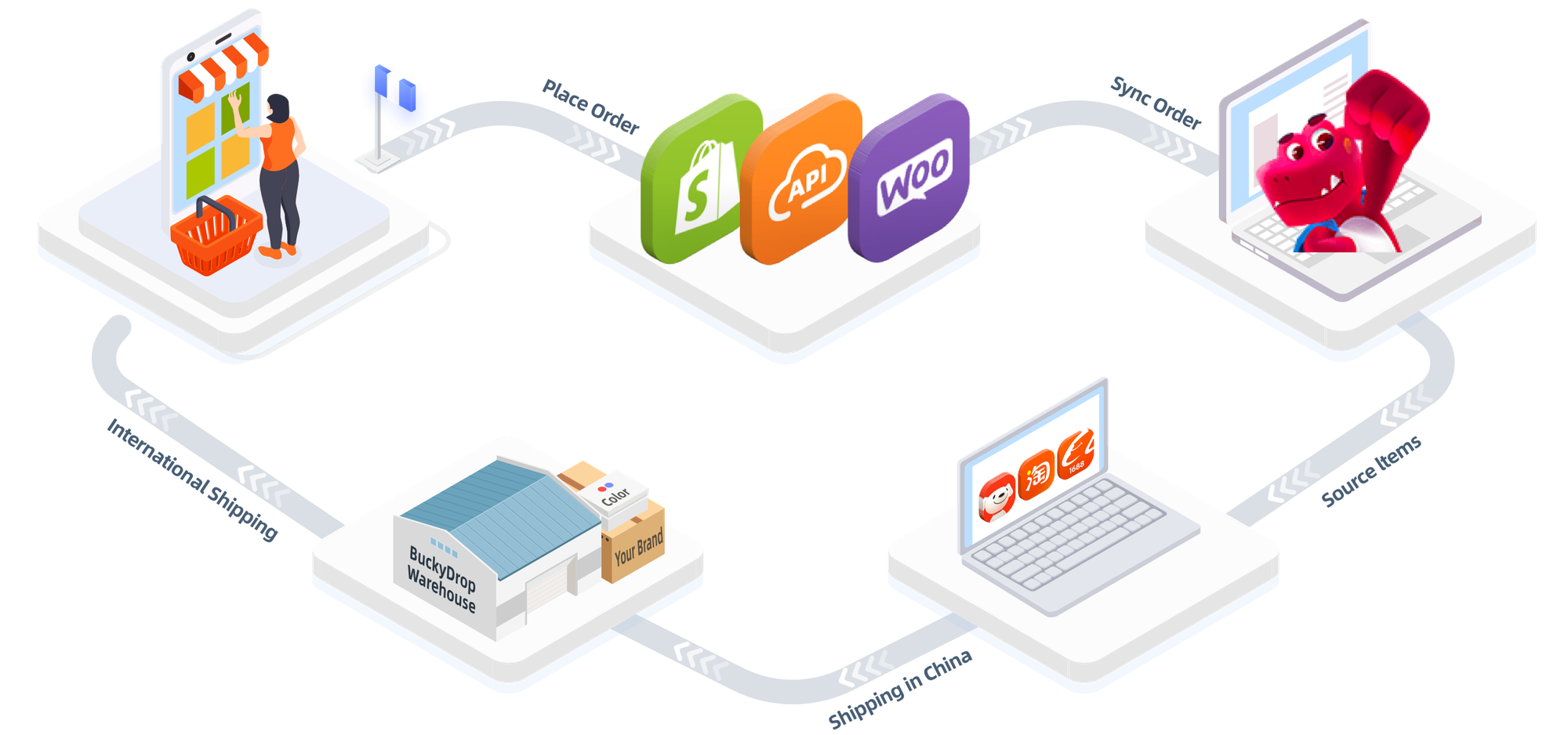
BuckyDrop fits best when the bottleneck is not your product page but your backend workflow.
If you are testing dropshipping from China, the hard parts usually happen after selection: binding the right variant, checking product quality, handling package processing, choosing a shipping route, syncing tracking, and keeping the customer updated.
Based on company-provided materials and public app/plugin listings, BuckyDrop is designed to support China sourcing, Shopify and WooCommerce-connected workflows, order sync, inventory updates, tracking sync, quality checks, package handling, and branded packaging options.
BuckyDrop’s Shopify App Store listing describes access to China sourcing, private labeling, custom packaging, quality checks, order management, stock and price sync, and tracking updates. Its WooCommerce plugin listing describes sourcing from Chinese ecommerce marketplaces, product import, quality control, branded packaging, and global logistics for WooCommerce sellers.
For sellers comparing Chinese dropshipping options, the key question is not only “Can I find products?” It is whether the workflow can support product sourcing, procurement, quality checks, package handling, shipping route selection, and tracking updates without adding unnecessary manual work.
That does not mean every seller should use it. You still need to verify pricing, route availability, service scope, packaging options, and support expectations before scaling.
Brand at a Glance: BuckyDrop
Area | What to Know |
Core use case | China sourcing, automated fulfillment, branded dropshipping workflow |
Relevant sellers | Shopify sellers, WooCommerce sellers, API-connected teams, sellers testing products from Chinese marketplaces |
Public platform signals | Shopify App Store listing and WordPress/WooCommerce plugin listing |
Useful for pet product testing | Sourcing, quality checks, packaging options, tracking sync, and fulfillment workflow support |
What to verify first | Pricing, shipping routes, service scope, package handling, return/replacement process, support expectations |
Not a replacement for | Product validation, compliance review, paid ad testing, customer service policy, or brand positioning |
Who BuckyDrop Is Best For
BuckyDrop may fit sellers who already understand their customer but need a more structured sourcing and fulfillment workflow.
It can be relevant if you run a Shopify or WooCommerce pet store, want to source from Chinese marketplaces, need branded packaging options, and want order and tracking workflows that are less manual than copying orders into supplier chats.
It may also fit sellers who are moving from one-off dropshipping tests into a more branded model. For example, pet apparel, grooming accessories, travel items, and seasonal bundles may benefit from better packaging, inserts, labels, or product handling once a product passes its first test.
If your current problem is supplier chaos, variant mistakes, slow tracking visibility, or a growing fulfillment queue, reviewing dropshipping fulfillment services may be more useful than adding more products to your store.
Who BuckyDrop Is Not For
BuckyDrop is probably not the right fit if you need guaranteed domestic two-day delivery, a fully U.S.-based inventory model, or a provider that handles pet food compliance for you.
It is also not a shortcut around product validation. If a product has unclear materials, weak supplier photos, confusing variants, or a high defect risk, automation will not fix the underlying SKU problem.
Use BuckyDrop or any other provider only after you have checked the product, the supplier, the package size, and the customer promise. If you are comparing dropship services, verify platform support, sourcing coverage, tracking sync, packaging options, shipping routes, and support boundaries before moving volume.
Example Testing Scenario
This is an example scenario, not a reported customer result.
A small North American pet store wants to test trending pet products for dropshipping without overwhelming its manual fulfillment queue. Instead of importing 50 SKUs, the seller starts with four:
· Portable dog water bottle
· Paw cleaner
· Cat enrichment toy
· Reflective dog harness
The seller orders samples first, records short videos, checks packaging quality, and confirms variant mapping. Then the store runs low-budget creative tests on TikTok and Meta. Each product gets one landing page, one short demo video, and one clear shipping estimate.
After 20 orders, the seller reviews tracking return, delivery complaints, refund requests, and product-specific questions. If the paw cleaner has low support workload and good feedback, it becomes a bundle candidate. If the harness creates sizing complaints, the seller either improves the size chart or pauses it.
That is the right rhythm: sample first, run a small order test, read the support tickets, then decide whether the product deserves more ad spend.
Common Mistakes to Avoid
The first mistake is choosing products only because they are viral. A viral TikTok clip is not a sourcing plan.
The second mistake is ignoring package size. Pet beds, carriers, and car seat covers can look profitable until you calculate shipping volume and return handling.
The third mistake is using supplier images without testing the real product. Pet owners are emotionally attached to their animals. If the product looks cheap, unsafe, or different from the listing, support pressure comes fast.
The fourth mistake is scaling before tracking works. If tracking does not return to your store in a way customers can understand, your support team becomes the tracking system.
The fifth mistake is making health or safety claims you cannot support. Stay practical. Sell convenience, comfort, cleanliness, enrichment, travel, and organization. Do not make medical promises.
The sixth mistake is adding too many variants too soon. Apparel, harnesses, beds, and carriers can create size-related returns if the chart is weak or supplier variants are inconsistent.
Related Reading
If you are still comparing dropshipping sites or looking for the best dropshipping websites for China sourcing and fulfillment, review how product sourcing, order sync, tracking updates, branded packaging, and support boundaries fit into your actual store workflow.
For sellers comparing dropship fulfillment services, the key question is not only price. It is whether the provider can support your SKU and variant matching, fulfillment exceptions, and customer tracking expectations.
FAQ
Are pet products good for dropshipping in 2026?
Yes, but only if you choose carefully. The U.S. pet market remains large, but a large market does not make every product a good SKU. Start with products that solve visible owner problems, ship at a manageable cost, and create fewer compliance or support risks.
What pet products are safest for beginners to dropship?
Beginner-friendly products are usually lightweight, non-electronic, non-consumable, and easy to demonstrate. Paw cleaners, grooming gloves, lick mats, slow feeders, portable dog water bottles, and simple cat enrichment toys are better starting points than smart feeders, pet cameras, oversized beds, or supplements.
Should I dropship pet food, treats, or supplements?
Most small dropshipping sellers should be cautious. Pet food, treats, and supplements involve food safety, labeling, import, and health-claim risk. Review FDA guidance and verify supplier compliance before selling. If you cannot verify the supply chain, choose non-consumable accessories instead.
Can I sell these products on Shopify or WooCommerce?
Yes, Shopify and WooCommerce can support pet product stores. The harder part is fulfillment workflow: supplier reliability, SKU matching, order sync, tracking, refunds, and support. Verify platform integration and service scope before scaling any provider.
How many pet products should I test first?
Start with three to five products, not 30. Pick different buyer problems: grooming, walking, travel, enrichment, and seasonal comfort. Run 10 to 20 real orders before increasing ad spend. Watch support tickets, refund reasons, tracking quality, and real cost per fulfilled order.
What margin should I aim for?

Pricing may vary by product, supplier, destination, shipping route, ad cost, return rate, and support workload. Do not rely on supplier cost alone. Calculate cost per fulfilled order, including procurement, handling, packaging, shipping, transaction fees, refunds, and support time.
Do I need to order samples before selling pet products?
Yes. For pet products, samples are not optional if you plan to run paid traffic. Test material quality, packaging, sizing, safety, instructions, and whether the product matches supplier images.
Which pet products should I avoid with a small budget?
Avoid bulky beds, fragile electronics, complex smart devices, consumables, supplements, and products with unclear safety claims. Also avoid products with too many size variants unless you can build a strong size guide and handle exchanges.
Is BuckyDrop only for beginners?

No. BuckyDrop may be useful for beginners who want sourcing and fulfillment support, but its stronger fit may be sellers who already have a Shopify or WooCommerce store and need more supplier-side visibility, branded packaging options, order sync, tracking updates, and fulfillment workflow support. Verify pricing, service scope, and route availability before scaling.
Final Recommendation + CTA
The products worth testing in 2026 are the ones that can survive boring operational checks: package size, defect risk, tracking, returns, and customer expectations.
Start with simple, visible, low-risk products: paw cleaners, lick mats, slow feeders, grooming gloves, portable dog water bottles, and enrichment toys. Move into fountains, smart feeders, pet cameras, beds, and carriers only when your product page, supplier checks, and support workflow are ready.
If pet products are your next test category, do not start by importing 50 random SKUs. Connect your Shopify or WooCommerce store to BuckyDrop, choose three to five low-risk products, and run your next 10 to 20 orders as an operational test.
Measure supplier issues, tracking return speed, refund requests, support tickets, and real cost per fulfilled order. If the workflow holds up, increase ad spend. If it does not, fix the sourcing, product page promise, or fulfillment process before scaling.
Start with BuckyDrop as an all in one dropshipping platform.
Sources
1. APPA 2026 State of the Industry Report
3. Shopify Dropshipping Documentation
4. Shopify Legal Dropshipping Guidance
5. WooCommerce Dropshipping Documentation
6. Google Search Central: Creating Helpful, Reliable, People-First Content
8. BuckyDrop Shopify App Store Listing
9. BuckyDrop WooCommerce Plugin Listing
10. Source: company-provided BuckyDrop overview