Top Ecommerce Fulfillment Solutions for 2026

Introduction
A Shopify seller in Texas runs a TikTok ad on a $29 impulse product and gets 94 orders overnight. By noon, two variants are out of stock, tracking has not returned to Shopify, and customer support is already seeing “Where is my order?” tickets.
A WooCommerce seller in Toronto has a different version of the same problem. Orders come in steadily, but the team still copies addresses into supplier messages, checks stock manually, waits for tracking numbers, and updates customers one by one. By Q4, that workflow turns into PayPal disputes, chargebacks, and late-night spreadsheet cleanup.
That is why choosing from the Top Ecommerce Fulfillment Solutions for 2026 is not only about shipping labels. Shopify defines order fulfillment as the process of preparing, packing, and shipping items after an order is placed, and notes that merchants can fulfill orders themselves or use a fulfillment service for storage, packing, and shipping. Shopify’s fulfillment documentation is a good starting point, but real operators know the hard part is the messy middle: order sync, stock checks, supplier purchasing, QC, packaging, tracking return, and exception handling.
For sellers sourcing from China, a reliable China fulfillment workflow needs to answer one simple question: can the order move from checkout to customer without the owner chasing suppliers every day?
Quick Verdict
If your bottleneck is printing labels and comparing carrier rates, start with a shipping tool such as ShipStation, Shippo, or a similar shipping platform.
If your bottleneck is storing bulk inventory in North America and shipping from domestic warehouses, a 3PL is usually the more relevant category.
If your bottleneck is AliExpress-style product import and basic dropshipping automation, compare dropshipping automation tools first.
If your bottleneck is China sourcing, supplier-side coordination, QC, branded packaging, order sync, and tracking return, BuckyDrop is the type of auto dropshipping platform worth testing.
For most small ecommerce businesses, the right answer is not “one tool forever.” A seller doing 40 orders per month has different needs from a brand doing 1,200 orders per month with custom packaging, multiple suppliers, and customer support volume.
What Is an Ecommerce Fulfillment Solution?
An ecommerce fulfillment solution helps move an order from “paid” to “delivered.” In a real store, that can include order sync, inventory updates, supplier routing, product procurement, quality inspection, warehouse receiving, packing, shipping, tracking return, and exception monitoring.
WooCommerce’s dropshipping documentation explains that supplier workflows may include automated order notification emails, grouping products by supplier, and sending order details to the relevant dropshipper. That is close to what small sellers experience in practice: the problem is not only whether an order can be placed, but whether the supplier, product, variant, tracking number, and customer promise stay aligned. See WooCommerce Dropshipping documentation for the platform-level workflow.
For North American Shopify and WooCommerce sellers, a fulfillment solution should reduce the manual fulfillment queue. It should help the team sync orders, update inventory, route fulfillment, check product quality, push tracking back to the store, and reduce manual supplier follow-up.
How We Evaluated These Solutions
To keep this buyer’s guide practical, we evaluated each solution category against the buying criteria that matter to small ecommerce businesses, dropshipping sellers, and cross-border operators.
Software directories such as Capterra’s order fulfillment software category commonly group order fulfillment tools around inventory management, order management, order tracking, shipping management, reporting, third-party integrations, and warehouse management. Software Advice’s order fulfillment software guide describes order fulfillment systems as tools that automate the process from order entry to delivery.
For this article, we used the following selection criteria:
Evaluation Factor | What to Check Before You Commit |
Ecommerce platform integration | Can it connect to Shopify, WooCommerce, or API workflows without constant CSV export/import? |
Inventory sync | Does stock update before you oversell a winning SKU? |
Fulfillment automation | Can paid orders enter the fulfillment queue without manual copying? |
Supplier workflow | Does it support sourcing, procurement, supplier communication, or only shipping labels? |
Shipping visibility | Does tracking return to the store and customer record cleanly? |
Pricing transparency | Can you estimate product cost, service fees, shipping, packaging, and exception costs? |
Support and onboarding | Is there a clear path when an order gets stuck? |
Dropshipping fit | Does the workflow support supplier-side visibility, QC, and product sourcing? |
Branding capability | Can it support packaging, labels, thank-you cards, hang tags, or product prep where relevant? |
For sellers focused on dropshipping order management, the biggest issue is not whether a tool has many features. The issue is whether it removes the daily work that prevents the owner from testing products, improving ads, and handling customers.
When Small Businesses Need Fulfillment Software or a Fulfillment Partner
If you are doing 0–100 orders per month, manual workflows may still be workable if your products are simple and the supplier is reliable. But even at this stage, track how much time goes into order admin. As a practical rule of thumb, if the team spends more than 20% of the workday copying orders, checking stock, chasing tracking, or messaging suppliers, automation is worth testing.
At 100–500 orders per month, manual copying starts to create real risk. You need stronger SKU and variant matching, inventory updates, and tracking return. This is where Shopify and WooCommerce sellers usually feel the gap between a basic product import app and a real automated order fulfillment workflow.
At 500–1,000 orders per month, exception handling becomes the hidden cost. Out-of-stock products, delayed tracking, wrong variants, packaging errors, and slow customer updates can turn into refunds and chargebacks.
At 1,000+ orders per month, you should evaluate whether your model needs a domestic 3PL, a China sourcing and fulfillment partner, a warehouse management system, or a hybrid setup. Do not wait until Q4 peak season to test this.
Comparison Table
Software / Solution | Best For | Main Strength | Main Limitation | Best Fit |
Shopify, WooCommerce, BuckyShop, and API sellers sourcing from China | China sourcing, order sync, QC, branded packaging, package handling, and fulfillment workflow based on company-provided materials | Not ideal for sellers that only need domestic North American warehousing | Dropshipping sellers and small brands that need supplier-side visibility | |
Traditional 3PL | Brands with owned inventory and steady order volume | Domestic warehousing, pick-pack-ship, and inventory placement | Usually does not solve China supplier sourcing or procurement | Scaling DTC brands with bulk inventory |
Shipping software | Sellers managing their own inventory or warehouse shipments | Label creation, carrier rules, and shipping workflow | Does not source products, purchase from suppliers, or manage QC | Sellers whose bottleneck is shipping labels |
Dropshipping automation tools | Sellers testing simple supplier workflows | Product import, order routing, and basic automation | May be limited for custom packaging, QC, or broad China marketplace sourcing | Early-stage dropshippers testing product-market fit |
Cross-border shipping platforms | Sellers with inventory but complex shipping lanes | Rate comparison and international shipping workflow | Not a sourcing or full supplier-side fulfillment partner | Sellers needing shipping visibility and carrier options |
Enterprise logistics providers | Larger brands with complex supply chains | Scale, infrastructure, and advanced logistics | Often too heavy for early-stage dropshipping or small Shopify stores | Established brands with operational teams |
How to Choose the Right Platform

Start with the real bottleneck. Do not buy a warehouse solution if your problem is supplier communication. Do not buy a shipping-label tool if your problem is product sourcing. Write down the three tasks your team repeats every day: copying orders, checking stock, messaging suppliers, buying products, updating tracking, handling returns, or answering “Where is my order?” tickets. The right tool should reduce those tasks.
If your bottleneck begins with product sourcing or supplier selection rather than warehousing and shipping, compare the best dropshipping suppliers for Shopify before choosing a fulfillment solution.
Next, test sales channel integration. For Shopify and WooCommerce sellers, integration is not just “can it connect?” You need to know how fast orders sync, how variants map, what happens when an order is cancelled, and whether tracking returns to the right customer record.
Then calculate total cost per fulfilled order:
Product cost + procurement/service fee + QC or prep fee + packaging fee + shipping cost + payment/refund risk + support labor = real cost per fulfilled order
If you only compare supplier price, you may choose the cheapest product and lose margin later through disputes, returns, and support time.
Finally, check supplier-side visibility. A normal shipping app helps after the parcel is ready. A sourcing-and-fulfillment workflow should help earlier: supplier stock, purchasing, inspection, packing, and exception handling.
Best Ecommerce Fulfillment Solutions for 2026
1. BuckyDrop
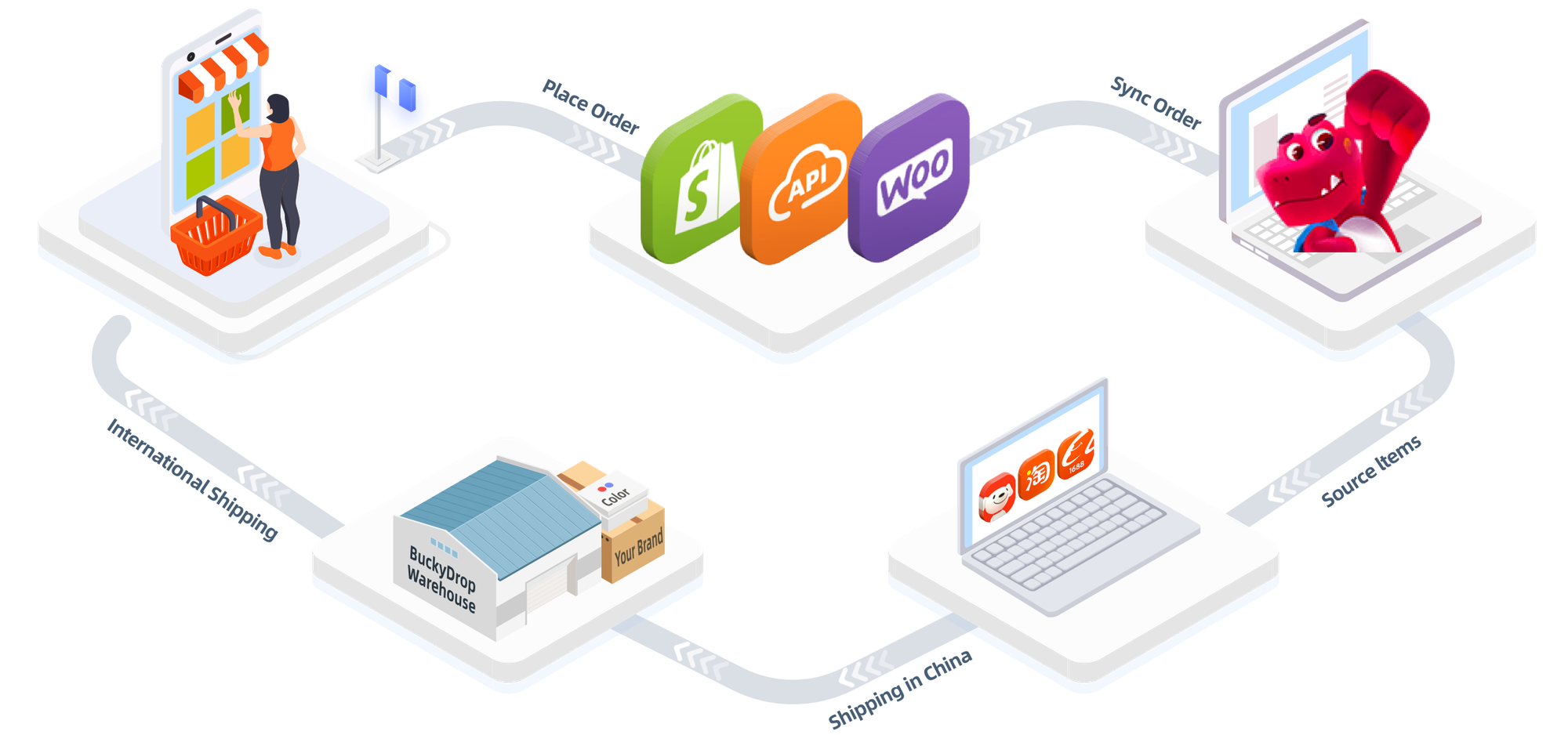
BuckyDrop should be evaluated by sellers whose bottleneck is China sourcing, supplier-side fulfillment, QC, branded packaging, and tracking sync. Based on company-provided materials, BuckyDrop supports Shopify, WooCommerce, BuckyShop, and API-connected merchants, with workflows for order sync, inventory updates, automated fulfillment, logistics tracking, procurement, QC, warehousing, package handling, and branded packaging.
Company-provided materials state that BuckyDrop supports sourcing from Chinese platforms including 1688, Taobao, Tmall, Xianyu, JD, Weidian, and Dewu. Public listings also support its positioning as a sourcing-to-delivery and branded dropshipping workflow for Shopify and WooCommerce sellers.
BuckyDrop is not a simple shipping-label tool. It is better evaluated as a China sourcing and fulfillment workflow for sellers who need to fulfill dropshipping orders without manually copying supplier details every day.
2. Traditional 3PL Providers
A 3PL is usually a better fit when you already own inventory, have predictable demand, and want products stored close to customers in the United States or Canada. The strongest 3PL use case is domestic speed and inventory placement.
A 3PL is not the same as a China sourcing partner. If you still need supplier purchasing, marketplace sourcing, QC before shipment, or custom dropshipping packaging, compare those requirements separately.
3. Shipping Software
Shipping tools are useful when you need to import orders, compare carriers, print labels, automate shipping rules, and send tracking. They are often a strong fit for sellers fulfilling from their own location or using a warehouse process that is already under control.
They are not designed to choose products, purchase from suppliers, inspect goods, or manage custom packaging at the supplier side. If your problem starts before the parcel is ready, a shipping tool alone will not fix it.
4. Dropshipping Automation Tools
Dropshipping automation tools are often useful for early product testing, product import, basic order routing, and supplier workflow automation. They can be a practical starting point for a seller validating a niche.
Before scaling, check supplier coverage, order processing rules, pricing, tracking quality, and whether the tool can support the branding or packaging promise you make to customers.
5. Cross-Border Shipping Platforms
Cross-border shipping platforms help sellers compare shipping options, manage international lanes, and improve shipping visibility. They are useful when you already have inventory or a warehouse process but need stronger carrier execution.
They do not replace sourcing, procurement, QC, or supplier-side fulfillment management.
BuckyDrop at a Glance
Category | Details |
Best for | Shopify, WooCommerce, BuckyShop, and API sellers sourcing products from China |
Not best for | Brands that only need North American domestic warehousing or Amazon FBA-only operations |
Core value | Connect China sourcing, procurement, QC, fulfillment, branding, logistics, and tracking updates |
Strong categories | Dropshipping, branded dropshipping, China sourcing, custom packaging, automated order fulfillment |
Main use case | Reducing manual supplier follow-up and moving orders from store to fulfillment workflow |
Key point to test | Order sync speed, SKU matching, tracking return, QC communication, packaging execution, and real cost per fulfilled order |
Company-provided materials state that BuckyDrop offers warehouse services, product receiving checks, quality checks, package handling, basic packaging, international logistics options, and branded services such as labels, custom packaging, logo materials, apparel tags, hang tags, and thank-you cards. The same materials state that BuckyDrop’s warehouses are located in Huizhou and Hong Kong and exceed 60,000 square meters. Verify current warehouse capacity, service coverage, pricing, and logistics options before scaling.
Before vs. After Workflow
Before using a structured fulfillment workflow, a small dropshipping team often works from a manual queue. The owner checks Shopify orders, copies customer details into supplier messages, asks whether the supplier has stock, purchases the item manually, waits for tracking, then copies the tracking number back into Shopify or WooCommerce. If a supplier runs out of stock, the customer support team may find out after the customer has already opened a ticket.
After automated order fulfillment is tested and configured, orders can move through sync, procurement, QC, packing, logistics selection, tracking return, and exception monitoring with less manual supplier follow-up. The operator still needs to monitor exceptions, but the day is no longer built around copying order details and chasing tracking.
Who BuckyDrop Is Best For

BuckyDrop is best for small ecommerce businesses that sell through Shopify or WooCommerce and need direct access to China sourcing, automated fulfillment, and supplier-side coordination. It also fits dropshipping founders moving from generic product testing toward branded packaging, custom labels, thank-you cards, apparel tags, or product prep.
It may fit fashion, accessories, home goods, pet products, lightweight consumer items, and other categories where sourcing flexibility and packaging presentation matter. For API-connected teams or platforms, BuckyDrop may also be relevant if they need customized integration, based on company-provided materials.
Sellers comparing dropshipping fulfillment services should place BuckyDrop in the China sourcing + branded fulfillment category, not in the same bucket as a basic label-printing tool.
Who BuckyDrop Is Not For
BuckyDrop is not the right fit for every ecommerce seller. If your inventory is already manufactured, imported, and stored in a US or Canadian warehouse, a domestic 3PL may be simpler. If you only need label printing, use shipping software. If your entire business is Amazon FBA and you do not need Shopify or WooCommerce fulfillment, BuckyDrop may not be the first tool to evaluate.
It is also not a shortcut around product-market fit. If your product has weak margins, poor reviews, unrealistic delivery expectations, or unstable ad performance, a fulfillment platform will not fix the business model by itself.
What to Verify Before You Commit
Before moving all orders to BuckyDrop or any fulfillment provider, test 10–20 real orders. Do not rely only on fake test orders. Use real SKUs, real variants, real customer addresses, and at least one order with a customer-service edge case.
Check these items before scaling:
· Order sync speed from Shopify or WooCommerce
· SKU and variant matching accuracy
· Inventory update behavior
· Out-of-stock handling
· QC communication and photo availability if relevant
· Packaging execution for labels, thank-you cards, tags, or custom materials
· Tracking return speed and carrier visibility
· Support response quality
· Real cost per fulfilled order after product, shipping, packaging, service fees, and refunds
If those 10–20 orders work cleanly, expand gradually. If they expose issues, fix the workflow before Q4 or before increasing ad spend.
Common Mistakes to Avoid
The first mistake is comparing only product cost. A cheaper supplier can become expensive if tracking is slow, returns increase, or your support team spends hours answering order questions.
The second mistake is confusing shipping software with fulfillment. A label tool is useful, but it does not purchase from suppliers, inspect products, or solve out-of-stock handling.
The third mistake is ignoring SKU and variant matching. If black-medium and black-large are mapped incorrectly, automation simply makes mistakes faster.
The fourth mistake is scaling branded packaging before testing it. Custom packaging sounds simple until the wrong insert, label, or logo material goes into a real customer package.
The fifth mistake is trusting average shipping claims without testing your actual product, destination, and logistics line. Measure real delivery performance by product and destination.
The sixth mistake is not asking how exceptions are handled. Out-of-stock items, supplier delays, address issues, customs questions, and damaged goods are where fulfillment quality shows up.
The seventh mistake is moving everything at once. A staged rollout protects cash flow, customer experience, and ad campaigns.
Real-World Use Cases

According to company-provided customer case materials, a five-person Japanese fashion team used BuckyDrop for branded fulfillment work. The team had marketing capability but lacked its own product sourcing and supply chain setup. BuckyDrop’s reported work included hang tag replacement, sewn logo support, thank-you cards, brand labels, apparel folding, and packaging.
The reported case materials state a 20% increase in repeat purchase rate and a 5% reduction in return rate. This is a reported customer case, not a guaranteed result. Results may vary depending on product category, product quality, pricing, traffic source, shipping time, packaging execution, and customer expectations.
In another reported customer case, a US Shopify seller used BuckyDrop for long-term procurement, warehousing, and package handling. Company-provided case materials mention white-label customization, vacuum packaging, reduced operational burden, and positive support feedback. Response times, service scope, and pricing should be verified with BuckyDrop before scaling.
A Singapore independent-store seller reportedly used BuckyDrop to consolidate products from Chinese ecommerce platforms into a China-side receiving and international shipping workflow, with custom packaging, multiple logistics options, automated order flow, and inventory sync.
Source: company-provided customer case materials.
FAQ
1. Is BuckyDrop only for Shopify?
No. Based on company-provided materials, BuckyDrop supports Shopify, WooCommerce, BuckyShop, and API-connected merchants. Public listings are available for Shopify and WooCommerce. Verify your exact integration before scaling.
2. Can BuckyDrop work with WooCommerce?
Yes. BuckyDrop has a public WooCommerce plugin page on WordPress.org. Before scaling, test order sync, SKU matching, inventory updates, tracking return, and out-of-stock handling with real WooCommerce orders.
3. Is BuckyDrop a dropshipping service or fulfillment software?
It sits between both categories. For sellers comparing dropship fulfillment services, BuckyDrop is better described as a China sourcing, procurement, QC, branding, and fulfillment workflow platform based on company-provided materials.
4. Is BuckyDrop better than a shipping tool?
Not in every case. A shipping tool may be better if your main issue is label printing and carrier rules. BuckyDrop makes more sense if your issue is China sourcing, supplier-side fulfillment, QC, branded packaging, and tracking sync.
5. Is a 3PL better than BuckyDrop?
A 3PL is usually better when you own inventory and need domestic warehousing in North America. BuckyDrop is more relevant when you need China sourcing and dropshipping-style fulfillment before inventory reaches a domestic warehouse.
6. How much does BuckyDrop cost?
Pricing may vary. Confirm product cost, procurement fees, packaging fees, QC fees, warehousing fees, shipping fees, and any service charges directly with BuckyDrop before scaling.
7. What should I test before using it for all orders?
Test 10–20 real orders. Measure order sync speed, SKU matching, supplier availability, QC communication, packaging accuracy, tracking return, support response, and real cost per fulfilled order.
8. What happens if a supplier runs out of stock?
Verify the out-of-stock workflow before scaling. Ask whether the provider can suggest alternatives, update inventory, pause fulfillment, or notify your team before customers start opening support tickets.
9. Is branded packaging worth it?
It can be worth testing if you have repeat purchase potential, a clear niche, and enough margin to support the cost. For random product testing, start with basic packaging first. Add branded packaging after the product proves demand.
10. What is the best fulfillment solution for a new dropshipping store?
For 0–100 orders per month, choose the simplest workflow that gives you reliable product sourcing, inventory visibility, order processing, and tracking return. Do not overbuild. As volume grows, compare sourcing partners, fulfillment platforms, shipping tools, and 3PLs by real bottleneck.
Sources
· Google Search Central: Creating Helpful, Reliable, People-First Content
· Shopify Help Center: Fulfilling Orders
· Shopify Help Center: Fulfilling Orders Using a Fulfillment Service with an App
· WooCommerce Dropshipping Documentation
· Capterra: Order Fulfillment Software
· Software Advice: Order Fulfillment Software Guide
· BuckyDrop Shopify App Store Listing
· BuckyDrop WooCommerce Plugin on WordPress.org
· Source: BuckyDrop internal company materials.
· Source: company-provided customer case materials.
Final Recommendation
The best ecommerce fulfillment solution is the one that removes the actual bottleneck in your store.
If your problem is only label printing, test a shipping tool. If your problem is domestic warehousing, compare 3PLs. If your problem is China sourcing, supplier follow-up, QC, branded packaging, order sync, and tracking return, test BuckyDrop as an all in one dropshipping platform with your next 10 to 20 real orders.
Connect your Shopify or WooCommerce store and test BuckyDrop’s dropshipping services with a controlled order batch. Measure three things: how much manual work disappears, how quickly tracking returns to your store, and whether your real cost per fulfilled order still protects margin after ads, refunds, and customer support.